Lab Members

I did not realise how rapidly my lab has grown.  So much that it made sense to have a lab outing (beer and pizza, really), and a chance for a group photo for those present.

This slideshow requires JavaScript.

I used to fear having a large lab, because of not being able to stay on top of everyone’s research project.  But when you have the right group of people, they help each other out with many of the day to day curiosities of university life.  Thanks to all you guys for being part of my lab.

Left to Right: Susan Wang, Justin Bridgeman, Anne Yagi, Curtis Abney, Me, Katlyn Dundas.

Photos taken by esteemed lab visitor, Kathryn Yagi.   Missing from photo: Viviana Cadena (who is writing up!) and lab mascot, Ceilidh (my dog) who was hiding somewhere in the house.

“Birds surviving the heat” symposium was a great success

Widely publicized heat waves have led to mortality and breeding failure of birds, and mortality of other taxa, including many humans, across the globe. Climate models predict further increased temperatures in addition to altered drought and other severe weather patterns, all of which can exacerbate thermal challenges. With a changing global climate, a major challenge facing scientists is to predict if and how species will survive rising temperatures.

Predicting these events requires models and an understanding of underlying thermal biology.  Mechanistic, process-based models allow us to predict how higher air temperatures and heat waves impact avifauna. Building these models relies on a detailed theoretical understanding of processes related to thermal stress, as well as parameterization with data from varied sources. Birds of arid habitats provide an ideal model system for developing mechanistic models because they face a number of physiological and behavioral constraints related to the avoidance of lethal hyperthermia and maintenance of water balance. These constraints are often manifested as consequential trade-offs affecting survival and reproduction. Recent catastrophic mortality events, most notably in the Australian arid zone, highlight the direct impacts that periods of extremely hot weather can have on desert birds. In addition, recent research has also revealed various more subtle impacts that only become apparent from detailed, species-specific studies, and/or consideration of the chronic effects of hotter daily conditions in addition to more extreme events.

It was for the above reasons that a team of concerned Physiologists assembled at the North American Ornithology Conference this past week (Aug 18, 2016) to participate in the following symposium topic:

“Surviving the heat: integrating physiology, behavior, and morphology to predict population responses to climate change”

Here were the broad topics covered:

Physiological tolerance limits. Predicting climate change impacts on endotherms using physiological tolerance limits is much more complex than it is for ectotherms. This aspect surveyed recent work aimed at quantifying avian heat tolerance and evaporative cooling capacity in a manner that allows for comparative analyses, and examined how these factors vary among biomes at a global scale.

Behavioral trade-offs and constraints as revealed by intensive, species-specific studies. This section focussed on recent work documenting consequential trade-offs between heat dissipation behaviors and foraging / provisioning nestlings, biologically relevant time scales of high temperatures, and the ways in which high temperatures affects social systems, with a focus on cooperative breeders. It also included work aimed at identifying behavioral indices of sensitivity to heat tolerance that can provide the basis for rapid assessments of species’ relative vulnerabilities to thermal stress.

Morphological responses to past and future climatic changes.  Morphological adjustments to climate that facilitate thermoregulation are widespread among birds, though little is known about the capacity for further adaptation in response to ongoing climate change. This aspect surveyed morphological adaptations to climate and discussed the potential for further change, including probable constraints, and consideration of how to incorporate this knowledge into process-based predictive models.

Spatial models. A key aspect of this symposium concerned ways in which species-specific physiological, behavioural, and morphological data could be incorporated into spatial models to predict responses to climate change, with a focus on the probability of extirpation. In addition to the presentations devoted to this topic, there were excellent talks on modeling avian distribution in the context of climate change to provide a backdrop against which to consider ideas from the empirical and theoretical presentations.

The symposium concluded with a 45 minute discussion session, during which future integrative directions were discussed, and short-comings of various approaches identified.  The symposium was well attended and we received excellent feedback from speakers and attendees.   Moreover, the participation of speakers from North America, southern Africa and Australia reflected the global focus of this symposium. Participants and attendees were exposed to novel techniques and analytical approaches presented by some of the world’s authorities.

I tried to get photos over everyone’s title slide (but not posting data or non-twitterable material), but missed a few (including my own!) due to my involvement in introducing speakers.


Names, affiliations, and titles of the speakers’ talks

South Africa

Susie Cunningham, University of Cape Town – Fitness costs of behavioral thermoregulation and threshold temperatures revealed by behavioral data sets

Michelle Thompson, University of Pretoria – Can heat dissipation behaviour be used as an indicator of underlying physiological stress?

Margaux Rat, University of Cape Town – The impact of elevated temperatures on social networks of a communal passerine, the Sociable Weaver Philetairus socius

Krista Oswald – Threats of climate change to a Fynbos-endemic bird: physiological responses show low heat tolerance thresholds irrespective of season in the Cape rockjumper (Chaetops frenatus)

Andrew McKechnie, University of Pretoria – Phylogenetic variation in heat tolerance and evaporative cooling capacity among Kalahari Desert birds

North America

Alex Gerson – Differential use of hyperthermia as a thermoregulatory strategy in birds exposed to high temperature.

Blair Wolf, University of New Mexico – Physiological challenges for desert bird communities in a rapidly warming world

David Luther – Males with larger bills sing at higher rates in a hot and dry environment

Bill Talbot – Surviving the heat: Nocturnal Sonoran Desert birds

Thomas Albright – Mapping lethal dehydration risk in desert birds of the Southwest USA under current and future climates: integrating physiology and microclimate

Ray Danner – Heat limits behavioral performance

Glenn Tattersall – Bills as radiators of body heat

Sekercioglu, Cagan – The effects of climate change on tropical birds


Australia

Janet Gardener – Temporal changes in avian body size over the last 50 years are associated with heat dissipation in Australian passerines


Many thanks to the NAOC organisers for allowing us to host this symposium!

Off to DC (again!) for my first Ornithology conference

Too many conferences this year, but it is a year of “firsts” for me.  Tomorrow I head to DC (twice this year), but this time for the North American Ornithological Conference.

NAOC Program.jpg

I’m co-organising the symposium “Surviving the heat: integrating physiology, behaviour, and morphology to predict population responses to climate change” with Blair Wolf, Andrew McKechnie, Susan Cunningham and Ray Danner.  I’ll be talking about my lab’s work on avian thermoregulatory responses.

NightHeron.png


Generating interest in your science and writing…

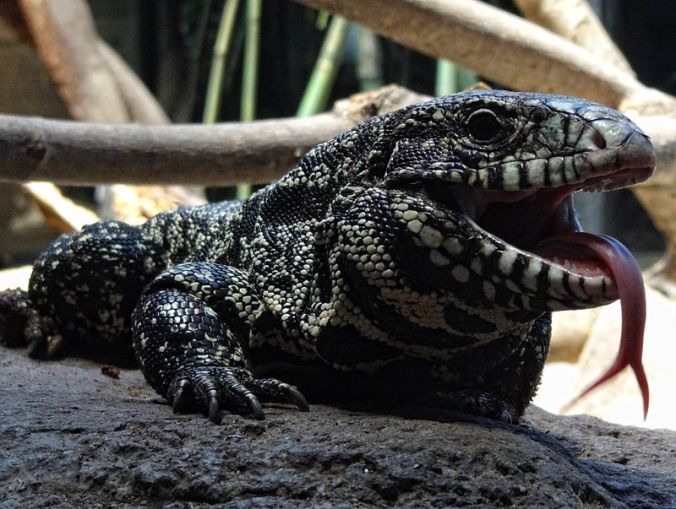
Scientists receive pressures from every angle to perform and justify their existence (parents, deans, students, bureaucrats, politicians, you name it..).  One reason for re-vamping my lab website was to keep a chronicle of lab activities as well as provide a more digestible version of our science to the public.  Since our work is sometimes highlighted by science writers and reporters, I had always assumed it was the scientists who had a tough time getting recognised.  Then I read the blog of a Science Writer, Diane Crow, who had contacted me a few months ago, interviewed me about our work on tegus.  She writes about how she tried to pitch her writing to news-outlets.  Sounds similar to a scientist’s challenge to get their work published.

18705862471_392b74c7db_o

For anyone interested in science writing and the challenges inherent to it, check out Diane’s blog:  http://dianacrowscience.com/543-2/

She gives an excellent and frank account of how a science writer has to make what scientists write interesting and friendly to readers.  Sadly, in the case of the tegu story,  this was a pitch that did not work, but that is one of the reasons why I wanted to post a link to her blog!  We appreciate your work!

Here’s to you Diane!   Keep up the good work and engagement on science!

Wisdom from Wikieup

A few months ago, I received an email from a name familiar to me by reputation and memory: Dr. Bayard Brattstrom. Bayard was known to me by his early work on thermal requirements of amphibians, although he has worked on a huge array of research from the fossils of the La Brea tar pits to the social behaviours in reptiles. He is now retired after a career spent mostly in California (Fullerton). He had contacted me after we published our discovery of endothermy in tegu lizards. I mentioned we would be in Vegas for a conference this July/August and that I would like to visit his Horned Lizard Ranch…I naively thought it would be a short drive from Vegas and that I would spend a few hours in the desert. Instead, Bayard very kindly invited me to stay for a few days to experience the place, so I went to the desert to seek wisdom from the Professor of Wikieup.

Anyhow, what a great experience. Two days of speaking with a herpetologist who was involved with so much research I have always admired. Bayard maintains an extensive personal library of herpetology research, lore, collectibles and memories. His house puts our department to shame in terms of its sheer breadth of literature, and from what I can tell, Bayard is working on 1 or 2 books in his spare time.  I certainly got a number of new ideas for research questions, and for anyone looking for a great desert field site, his lizard ranch is perfectly suited for any avid herpetologist.

I have posted a few images taken from his place here and wanted to thank him for his hospitality! Incidentally, the outside temperatures were 115 to 120F (real units: ~46 to 48oC!).

Off to the Hibernation meeting…in Vegas?

Tomorrow, I arrive in Las Vegas for the 15th International Hibernation Symposium.  A chance to catch up with a great group of people interested in understanding how animals survive the cold, or naturally drop body temperature and metabolism during periods of seasonal or daily energy sparing.  Why Vegas?  …because the organiser is from Vegas! Hoping this will be a fun conference!  We usually have a good time discussing body temperature, arguing concepts, seeing new data on interesting species (lots of new stuff from the tropics lately) and learning about the potential applications to biomedical science.  Anyhow, don’t worry I won’t be visiting the slots!

Conference Season continues…

My graduate student, Susan Wang, just returned from attending the American Parasitology Society conference, held in Edmonton, Alberta.  I was not able to attend with her, but she did a great job representing the lab, presenting on her ongoing work examining amphibian/parasite interactions.

Apparently her talk was runner-up for the unofficial best visuals used in a talk!

https://parasiteecology.wordpress.com/2016/07/20/winner-of-the-unofficial-asp-2016-cartoon-contest/#respond

I think I need to ask Susan to help put my talks together in the future!  Congratulations Susan!

ASP talk.png


Symposium was a success!

Just returned from the ICVM meeting and want to record my thoughts briefly here to remind me of the value of collaborations and pushing yourself outside your comfort zone.

I thoroughly enjoyed the morphology meeting.  What detailed accounts of evolutionary biology paleontologists and anatomists uncover is fascinating!  I could essentially choose any seminar at random, walk in, and simply learn about biology.  I was never bored, usually humbled, and never sleepy throughout the talks.

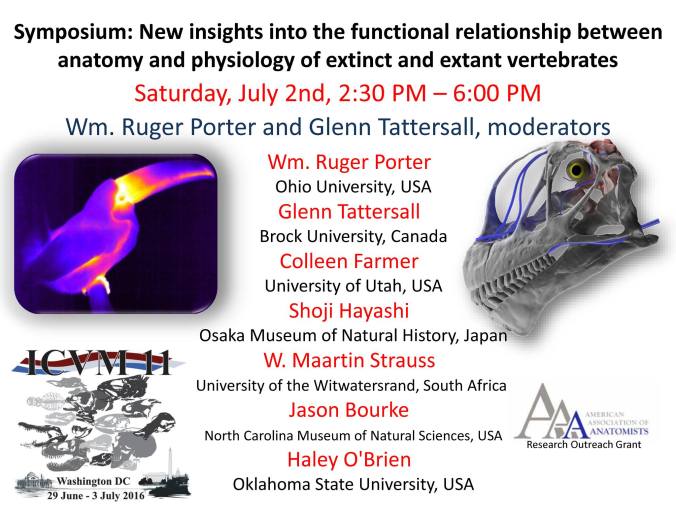
My reasons for attending this conference (outside what I consider to be my normal expertise) was because I co-organised a symposium with Dr. Ruger Porter that was ostensibly about using morphological traits to infer and understand thermoregulatory physiology.  We used the rather boring title “New insights into the functional relationship between anatomy and physiology in extinct and extant vertebrates” but in the end had a great line-up of speakers.  Sort of like chocolate and peanut butter, the mixture of morphologists and physiologists led to great discussions, and I hope some future collaborations and cross pollination of ideas.

Some of what they spoke on is still unpublished, so I won’t spoil their thunder by revealing it here, but suffice to say we had a great session learning on how the vascular system in the cranium is involved in brain temperature regulation, leading to fascinating discussions about the evolution of the artiodactyla.  We heard some brilliant work on using fluid dynamic modelling to estimate how much evaporative cooling and heat recovery would occur in select dinosaur lineages.  I spoke about my lab’s ongoing work using thermal imaging to explore the role of appendages (i.e. avian bills) in thermoregulation, which tied nicely into the paleontological work on cranial thermoregulation.  We also had two great talks on bone histology and metabolic rate in an array of mammals, where inference about the metabolic physiology of mammals can be drawn from traits preserved in their bones.

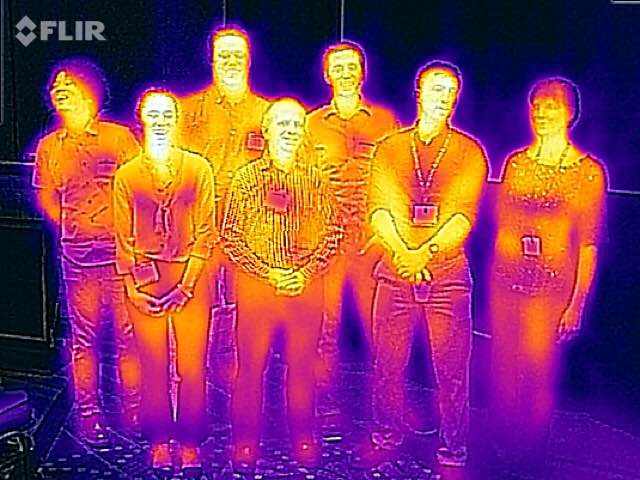
Kudos to all the participants (a very young and diverse crowd).  Here they are depicted in infrared:
 

SymposiumSpeakersinIR

Back row (left to right): Shoji Hayashi, Maartin Strauss, Ruger Porter.  Front row (left to right): Haley O’Brien, Glenn Tattersall, Jason Bourke, Colleen Farmer.

To anyone reading this post, please look up these authors and read some of their papers!  The kind of work we saw presented represent what you will find in the textbooks!


Burning love for our science?

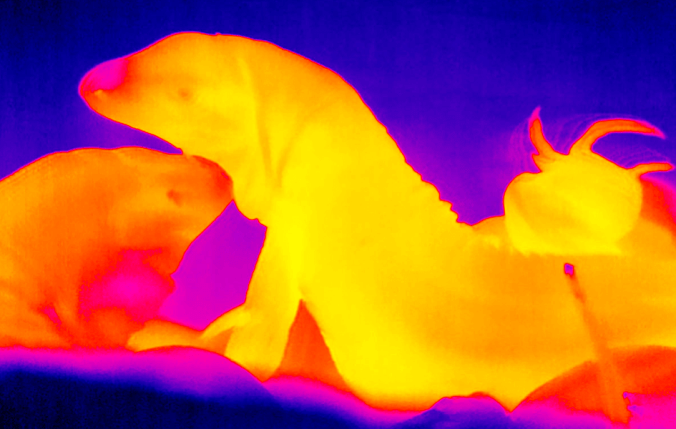
I just found out that an image from our published research has been selected by NSERC’s “Science Exposed” contest.  This photo is an actual research figure but also a captivating depiction of a novel discovery: namely endothermy in a lizard.

Teguthermal.png

Here is the photo.

The link to vote is here:

http://www.nserc-crsng.gc.ca/ScienceExposed-PreuveParLimage/index_eng.asp#vote-20

We would all appreciate your vote.  I know some of the other pictures are stunning landscapes and digitally rendered fluorescent images, but our lizard image is the genuine article.

For more information on the science article, please see:

http://advances.sciencemag.org/content/2/1/e1500951

Tattersall, GJ, Leite, CAC, Sanders, CE, Cadena, V, Andrade, DV, Abe, AS, and Milsom WK. 2016. Seasonal reproductive endothermy in tegu lizards. Science Advances. 2: e1500951.