Symposium was a success!

Just returned from the ICVM meeting and want to record my thoughts briefly here to remind me of the value of collaborations and pushing yourself outside your comfort zone.

I thoroughly enjoyed the morphology meeting.  What detailed accounts of evolutionary biology paleontologists and anatomists uncover is fascinating!  I could essentially choose any seminar at random, walk in, and simply learn about biology.  I was never bored, usually humbled, and never sleepy throughout the talks.

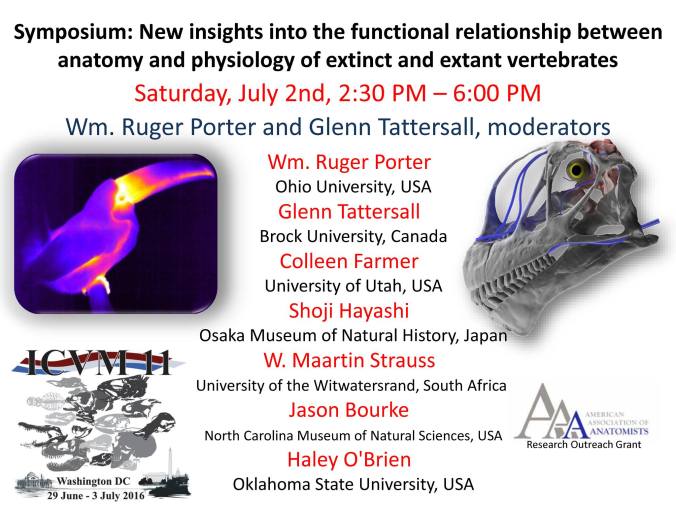
My reasons for attending this conference (outside what I consider to be my normal expertise) was because I co-organised a symposium with Dr. Ruger Porter that was ostensibly about using morphological traits to infer and understand thermoregulatory physiology.  We used the rather boring title “New insights into the functional relationship between anatomy and physiology in extinct and extant vertebrates” but in the end had a great line-up of speakers.  Sort of like chocolate and peanut butter, the mixture of morphologists and physiologists led to great discussions, and I hope some future collaborations and cross pollination of ideas.

Some of what they spoke on is still unpublished, so I won’t spoil their thunder by revealing it here, but suffice to say we had a great session learning on how the vascular system in the cranium is involved in brain temperature regulation, leading to fascinating discussions about the evolution of the artiodactyla.  We heard some brilliant work on using fluid dynamic modelling to estimate how much evaporative cooling and heat recovery would occur in select dinosaur lineages.  I spoke about my lab’s ongoing work using thermal imaging to explore the role of appendages (i.e. avian bills) in thermoregulation, which tied nicely into the paleontological work on cranial thermoregulation.  We also had two great talks on bone histology and metabolic rate in an array of mammals, where inference about the metabolic physiology of mammals can be drawn from traits preserved in their bones.

Kudos to all the participants (a very young and diverse crowd).  Here they are depicted in infrared:
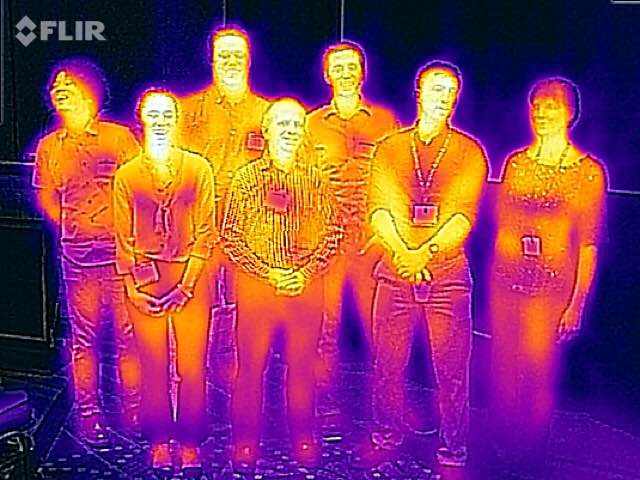
 

SymposiumSpeakersinIR

Back row (left to right): Shoji Hayashi, Maartin Strauss, Ruger Porter.  Front row (left to right): Haley O’Brien, Glenn Tattersall, Jason Bourke, Colleen Farmer.

To anyone reading this post, please look up these authors and read some of their papers!  The kind of work we saw presented represent what you will find in the textbooks!
 

Burning love for our science?

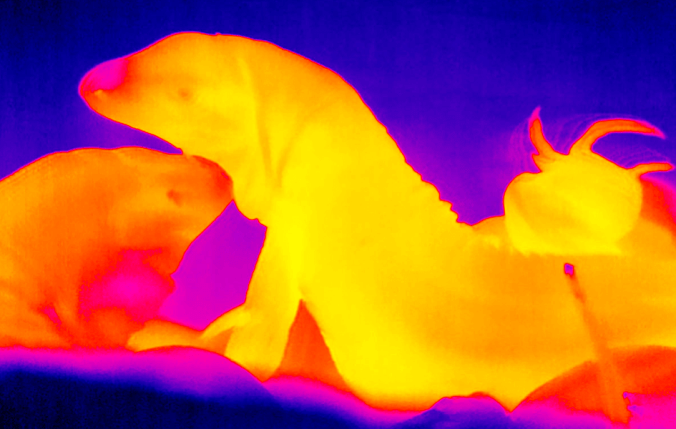
I just found out that an image from our published research has been selected by NSERC’s “Science Exposed” contest.  This photo is an actual research figure but also a captivating depiction of a novel discovery: namely endothermy in a lizard.

Teguthermal.png

Here is the photo.

The link to vote is here:

http://www.nserc-crsng.gc.ca/ScienceExposed-PreuveParLimage/index_eng.asp#vote-20

We would all appreciate your vote.  I know some of the other pictures are stunning landscapes and digitally rendered fluorescent images, but our lizard image is the genuine article.

For more information on the science article, please see:

http://advances.sciencemag.org/content/2/1/e1500951

Tattersall, GJ, Leite, CAC, Sanders, CE, Cadena, V, Andrade, DV, Abe, AS, and Milsom WK. 2016. Seasonal reproductive endothermy in tegu lizards. Science Advances. 2: e1500951.


Thermimage for R on CRAN

Rplot

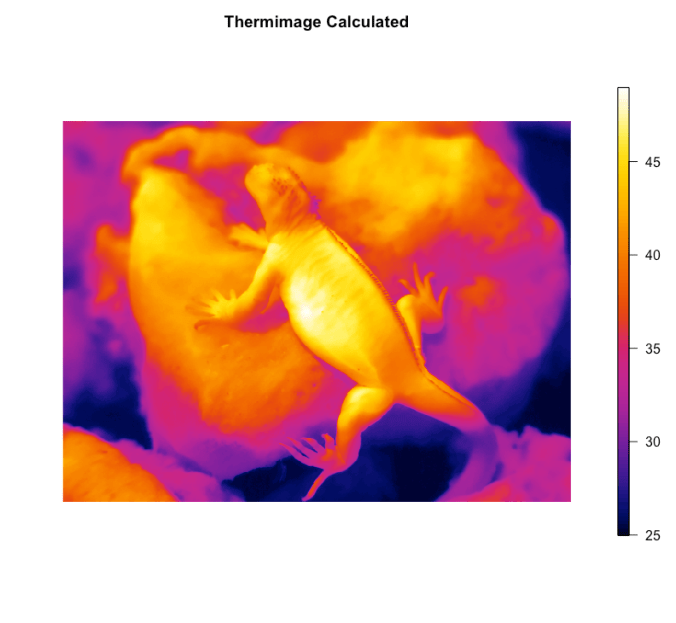
I’ve updated the Thermimage package.  The recent update includes calculations for modelling heat transfer from radiative and convective heat transfer from the animal to the environment, using temperatures captured from infrared thermal images.

The assumption is that the user already has temperature information captured and is simply using R to to analyse temperatures.  I am working on scripts for importing FLIR images into R but these are not yet included in Thermimage, since these scripts rely on external applications (EXIFTOOL) that have implementation issues in R.  (Edit: July 20, 2016, v 2.2.0 has a function for importing FLIR thermal jpgs for processing in R)

Thermimage is on Cran now at the following url:

https://cran.r-project.org/web/packages/Thermimage/index.html

Sample scripts on how to put the heat transfer equations to use are at:

https://github.com/gtatters/Thermimage/blob/master/heatcalc.R

I’ve also included a script to “test” the validity of the thermal image calculations where I convert the binary thermal image data into temperature:

https://github.com/gtatters/ThermimageCalibration/blob/master/ThermimageCheckCalculations.R

MarineIguana.png

Any issues with the code can be raised here:

https://github.com/gtatters/Thermimage/issues

Conference Season

It’s been a busy two weeks in the lab, courtesy of my hard working graduate students.  Susan, Justin and Anne presented their thesis research at the Ontario Ecology and Ethology Colloquium last week.  Here are some screen shots of their abstract titles.

oe3c-2016-final-program_may2oe3c-2016-final-program_may3

Then, this past week, the lab attended the Canadian Society of Zoologists conference to present our research.  Justin and Susan represented the lab work at Brock, while Cayleih Robertson (PhD student of Grant McClelland at McMaster) presented her work (a collaboration I’m happy to be part of).  Everyone gave excellent talks and appeared to enjoy the conference and workshops.

Susan Wang received an honourable mention for the CAS Lindsay Prize for best oral presentation in the Parasitism, Immunity, and Environment section. We’re all very proud of her!

JustinSusanCayleih

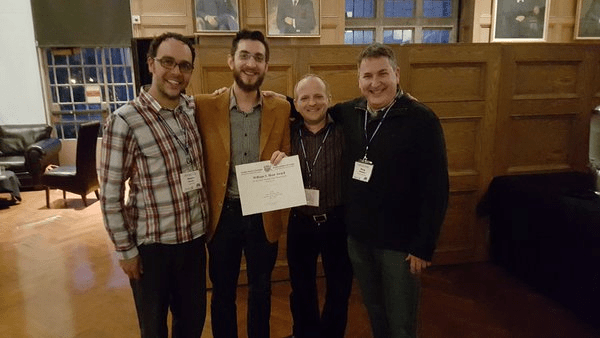
Finally, although Dimitri Skandalis left the lab a number of years ago, I was very pleased that Dimitri received the William S Hoar Award for best overall student presentation at the CSZ this year.    Here is is looking especially happy, as are his past and current supervisors (Left to Right: Darveau, Skandalis, Tattersall, Altschuler).

Dimitri and Supervisors.png

Thesis Defence a Success!

Congratulations to Ian Black for successfully defending his MSc thesis from research in my lab.   Ian’s thesis was entitled “Orientation Preference and Behavioural Thermoregulatory Coordination in Pogona vitticeps”.


Many thanks to Dr. Jacqueline Litzgus (Laurentian University) for being his external examiner and giving a fair and comprehensive assessment of his work.  Also thanks to Dr. Joffre Mercier, Dr. Robert Carlone and Dr. Alan Castle, committee members and defence committee for their gruelling questions.

I want to take this chance to thank Ian for being a member of the lab and for making it to this stage.  You will always be part of the lab and I wish you all the best in the future.  Enjoy the freedom of reaching a milestone.