Wisdom from Wikieup

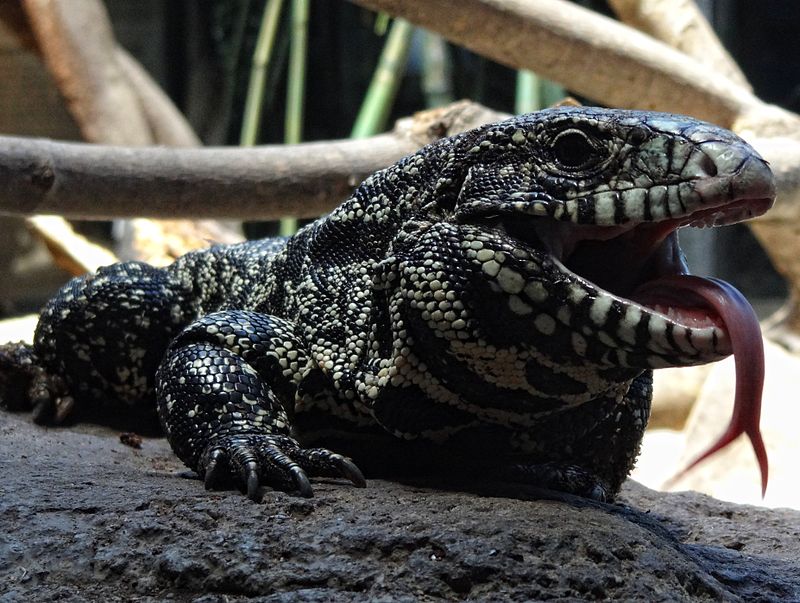
A few months ago, I received an email from a name familiar to me by reputation and memory: Dr. Bayard Brattstrom. Bayard was known to me by his early work on thermal requirements of amphibians, although he has worked on a huge array of research from the fossils of the La Brea tar pits to the social behaviours in reptiles. He is now retired after a career spent mostly in California (Fullerton). He had contacted me after we published our discovery of endothermy in tegu lizards. I mentioned we would be in Vegas for a conference this July/August and that I would like to visit his Horned Lizard Ranch…I naively thought it would be a short drive from Vegas and that I would spend a few hours in the desert. Instead, Bayard very kindly invited me to stay for a few days to experience the place, so I went to the desert to seek wisdom from the Professor of Wikieup.

Anyhow, what a great experience. Two days of speaking with a herpetologist who was involved with so much research I have always admired. Bayard maintains an extensive personal library of herpetology research, lore, collectibles and memories. His house puts our department to shame in terms of its sheer breadth of literature, and from what I can tell, Bayard is working on 1 or 2 books in his spare time.  I certainly got a number of new ideas for research questions, and for anyone looking for a great desert field site, his lizard ranch is perfectly suited for any avid herpetologist.

I have posted a few images taken from his place here and wanted to thank him for his hospitality! Incidentally, the outside temperatures were 115 to 120F (real units: ~46 to 48oC!).

Hibernation and Thermoregulation Research

I just came back from the International Hibernation Symposium (15th!) from Las Vegas and saw this article about one of our participants.  This is great to read, and helps explain why so many of us are passionate about understanding thermoregulation and hibernation.  Some work is biomedically inspired, some is evolutionarily inspired.  Anyhow, here is a nice article about Dr. Domenico Tupone, one of our colleagues and participants:

http://www.italoamericano.org/story/2016-8-4/domenico-tupone

Thanks for Dr. Matteo Cerri for sharing this link.

Off to the Hibernation meeting…in Vegas?

Tomorrow, I arrive in Las Vegas for the 15th International Hibernation Symposium.  A chance to catch up with a great group of people interested in understanding how animals survive the cold, or naturally drop body temperature and metabolism during periods of seasonal or daily energy sparing.  Why Vegas?  …because the organiser is from Vegas! Hoping this will be a fun conference!  We usually have a good time discussing body temperature, arguing concepts, seeing new data on interesting species (lots of new stuff from the tropics lately) and learning about the potential applications to biomedical science.  Anyhow, don’t worry I won’t be visiting the slots!

Conference Season continues…

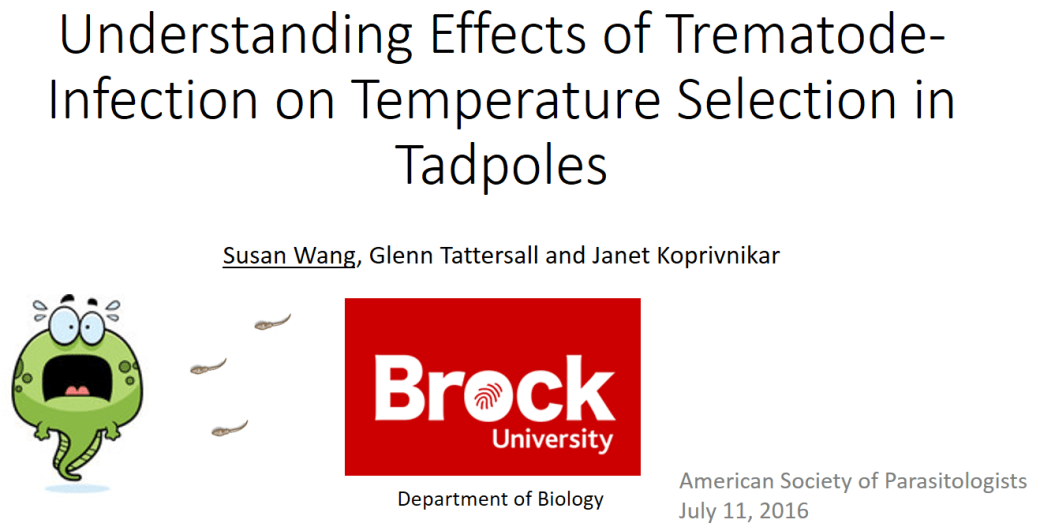
My graduate student, Susan Wang, just returned from attending the American Parasitology Society conference, held in Edmonton, Alberta.  I was not able to attend with her, but she did a great job representing the lab, presenting on her ongoing work examining amphibian/parasite interactions.

Apparently her talk was runner-up for the unofficial best visuals used in a talk!

https://parasiteecology.wordpress.com/2016/07/20/winner-of-the-unofficial-asp-2016-cartoon-contest/#respond

I think I need to ask Susan to help put my talks together in the future!  Congratulations Susan!

ASP talk.png


Symposium was a success!

Just returned from the ICVM meeting and want to record my thoughts briefly here to remind me of the value of collaborations and pushing yourself outside your comfort zone.

I thoroughly enjoyed the morphology meeting.  What detailed accounts of evolutionary biology paleontologists and anatomists uncover is fascinating!  I could essentially choose any seminar at random, walk in, and simply learn about biology.  I was never bored, usually humbled, and never sleepy throughout the talks.

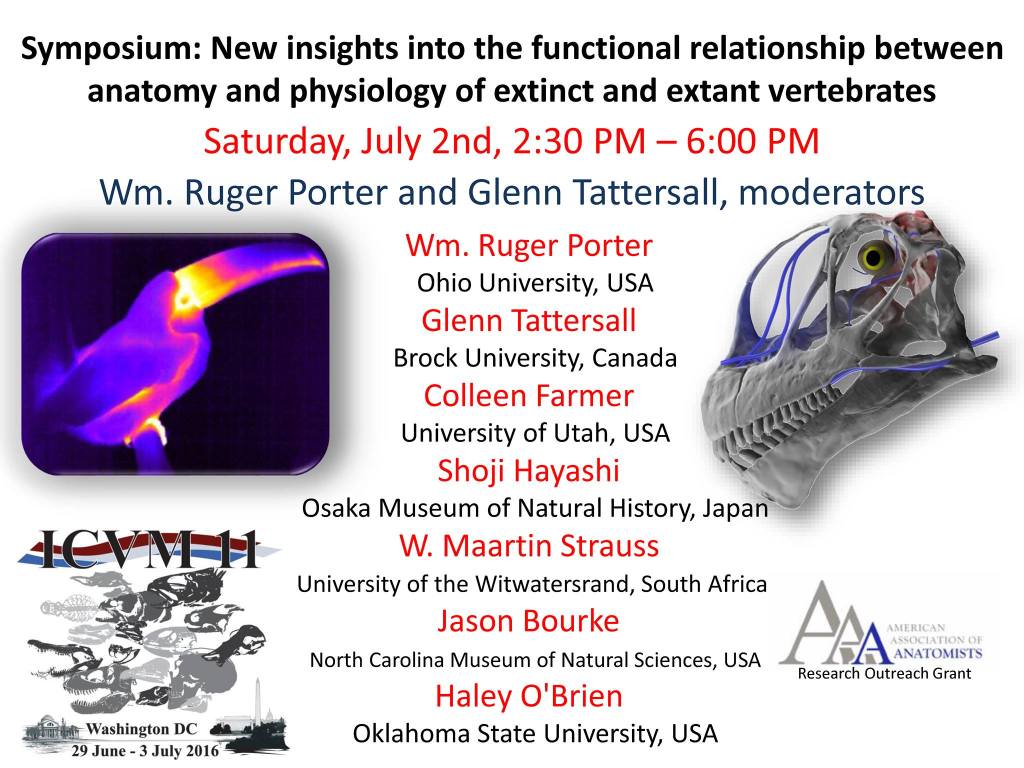
My reasons for attending this conference (outside what I consider to be my normal expertise) was because I co-organised a symposium with Dr. Ruger Porter that was ostensibly about using morphological traits to infer and understand thermoregulatory physiology.  We used the rather boring title “New insights into the functional relationship between anatomy and physiology in extinct and extant vertebrates” but in the end had a great line-up of speakers.  Sort of like chocolate and peanut butter, the mixture of morphologists and physiologists led to great discussions, and I hope some future collaborations and cross pollination of ideas.

Some of what they spoke on is still unpublished, so I won’t spoil their thunder by revealing it here, but suffice to say we had a great session learning on how the vascular system in the cranium is involved in brain temperature regulation, leading to fascinating discussions about the evolution of the artiodactyla.  We heard some brilliant work on using fluid dynamic modelling to estimate how much evaporative cooling and heat recovery would occur in select dinosaur lineages.  I spoke about my lab’s ongoing work using thermal imaging to explore the role of appendages (i.e. avian bills) in thermoregulation, which tied nicely into the paleontological work on cranial thermoregulation.  We also had two great talks on bone histology and metabolic rate in an array of mammals, where inference about the metabolic physiology of mammals can be drawn from traits preserved in their bones.

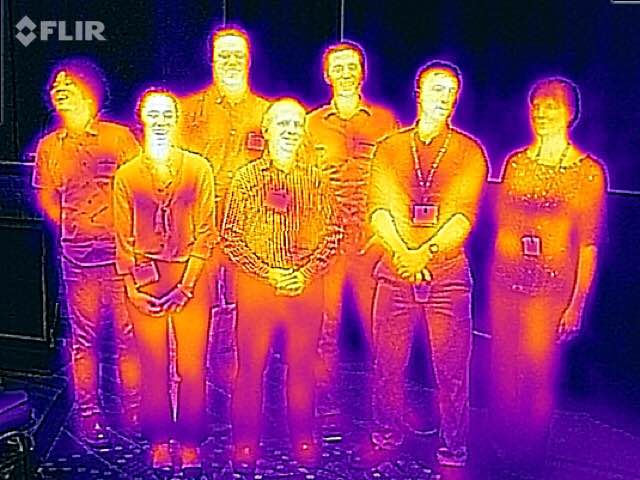
Kudos to all the participants (a very young and diverse crowd).  Here they are depicted in infrared:


SymposiumSpeakersinIR

Back row (left to right): Shoji Hayashi, Maartin Strauss, Ruger Porter.  Front row (left to right): Haley O’Brien, Glenn Tattersall, Jason Bourke, Colleen Farmer.

To anyone reading this post, please look up these authors and read some of their papers!  The kind of work we saw presented represent what you will find in the textbooks!


Burning love for our science?

I just found out that an image from our published research has been selected by NSERC’s “Science Exposed” contest.  This photo is an actual research figure but also a captivating depiction of a novel discovery: namely endothermy in a lizard.

Teguthermal.png

Here is the photo.

The link to vote is here:

http://www.nserc-crsng.gc.ca/ScienceExposed-PreuveParLimage/index_eng.asp#vote-20

We would all appreciate your vote.  I know some of the other pictures are stunning landscapes and digitally rendered fluorescent images, but our lizard image is the genuine article.

For more information on the science article, please see:

http://advances.sciencemag.org/content/2/1/e1500951

Tattersall, GJ, Leite, CAC, Sanders, CE, Cadena, V, Andrade, DV, Abe, AS, and Milsom WK. 2016. Seasonal reproductive endothermy in tegu lizards. Science Advances. 2: e1500951.


Hornbills and Toucans and Beaks…

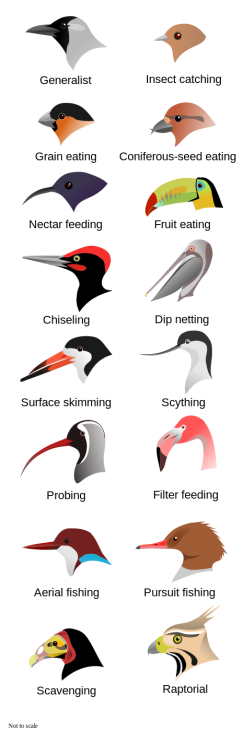
Avian bills are fascinating structures, having evolved a 465px-birdbeaksa-svgmyriad of forms and functions, as depicted in the montage on the right from: https://en.wikipedia.org/wiki/Beak
Today a new publication on this subject has been published in PLoS One, highlighting the multi-tasking capacity of form and function.  You can find it here and blogged about here.

The authors make the major point that hornbills use their bills like toucans do (as radiators of body heat, showing evidence of greater relative blood flow recruitment at warmer temperatures), but that their calculations suggest that the per area rate of heat exchange in the hornbills is less than the toucans.

This is a nice addition to the recent work done by a number of us in the field (see references below, e.g. Symonds and Tattersall, 2010), emphasizing that bills are not the dead, static structures that many assume they are.

One main point the authors note (they base their comparison mainly vs. toucans from our 2009 paper) is that the bills of hornbills are not as effective as dissipators of heat compared to the toucan and quite likely for multiple reasons: 1) the hornbills’ bill is thicker, so is a heavier barrier to heat exchange, likely because the hornbills use their bills as digging implements and must be more robust, and 2) toucans “switch on” their blood flow at lower temperatures than hornbills, and the lower the air temperature, the greater the driving force for heat loss, and 3) the hornbill bill is relatively smaller than the toucans.  The reason for the hornbill vs. toucan comparison is because the two lineages have long been viewed as old world vs. new world convergences (although that is really an oversimplification).

One point I’d like to emphasize that is often missed in the popular press.  These large billed birds are not unique in their bills’ thermal radiator function, since many other birds exhibit similar capacities to modify blood flow to their bills (geese, ducks, sparrows to name a few).  They are, however, striking in how large their bills are, which is why they garner such attention.

Here is a photograph of a hornbill (what mother could not love that face?):

Glenn_pic 2.jpg

Photo: Courtesy Dr. Andrew McKechnie


Hornbill.jpg

Figure from van de Ven (2016), showing the obvious blood vessels under the surface of the bill.

Some technobabble about how the measurements are made:

Like myself, these researchers used thermal imaging to obtain their results (see their paper for images and thermal videos), which means that heat exchange is an estimation of events and is done under sampling assumptions.  I’ve been working on calculations to make things easier for myself and colleagues (see below for R package), and came across a couple of things.  Firstly, some of the assumptions van de Ven et al (2016) used are different than the ones we made (Tattersall et al 2009).  We assumed higher wind speeds (5 m/s) in our modelling, which I think are a little on the high side of reality.  van de Ven et al (2016) on the other hand, assumed a wind speed of zero and therefore incorporated only free convection estimates.  Gates (2003 – Biophysical Ecology) advises that forced convection is the more realistic scenario for heat exchange in animals since wind speeds are rarely exactly zero, and suggests values between 0.5 and 1 m/s.  This means that van de Ven’s estimates of convective heat will be underestimates, while our toucan data are over-estimates.   Anyhow, the good news is that van de Den realized this when making comparisons to our previous work and made comparisons using free convective heat exchange (while politely not criticizing us for our over-zealous wind speeds).  The take home message though is that their published values for both species are on the low side, while our published values are more for what a flying bird might experience.

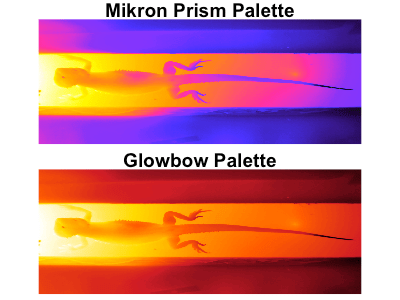
For anyone interested in using their thermal images for similar analyses, I have create a package in R called “Thermimage” to help in the calculations.

See https://cran.r-project.org/web/packages/Thermimage/index.html for the package itself and https://github.com/gtatters/Thermimage/blob/master/heatcalc.R for some sample scripts.

References

Gates, DM 2003. Biophysical Ecology.  Dover Publications, Mineola, NY, 611 pp.

Symonds M.R.E., Tattersall G.J. 2010 Geographical variation in bill size across bird species provides evidence for Allen’s rule. American Naturalist 176, 188-197. (doi:10.1086/653666).

Tattersall G.J., Andrade D.V., Abe A.S. 2009 Heat exchange from the toucan bill reveals a controllable vascular thermal radiator. Science 325, 468-470. (doi:10.1126/science.1175553).

van de Ven T.M.F.N., Martin R.O., Vink T.J.F., McKechnie A.E., Cunningham S.J. 2016 Regulation of Heat Exchange across the Hornbill Beak: Functional Similarities with Toucans? Plos One 11, e0154768. (doi:10.1371/journal.pone.0154768).

Additional sources

Greenberg R., Danner R.M. 2012 The Influence of the California marine layer on bill size in a generalist songbird. Evolution 66, 3825-3835. (doi:Doi 10.1111/J.1558-5646.2012.01726.X).

Greenberg R., Danner R., Olsen B., Luther D. 2012 High summer temperature explains bill size variation in salt marsh sparrows. Ecography 35, 146-152. (doi:Doi 10.1111/J.1600-0587.2011.07002.X).

Greenberg R., Cadena V., Danner R.M., Tattersall G.J. 2012 Heat loss may explain bill size differences between birds occupying different habitats. Plos One 7. (doi:ARTN e40933 DOI 10.1371/journal.pone.0040933).

Hughes A.L. 2014 Evolution of bill size in relation to body size in toucans and hornbills (Aves: Piciformes and Bucerotiformes). Zoologia-Curitiba 31, 256-263.

McNab B.K. 2001 Energetics of toucans, a barbet, and a hornbill: Implications for avian frugivory. Auk 118, 916-933.

Seki Y., Bodde S.G., Meyers M.A. 2010 Toucan and hornbill beaks: A comparative study. Acta Biomater 6, 331-343.
Thermimage for R on CRAN

Rplot

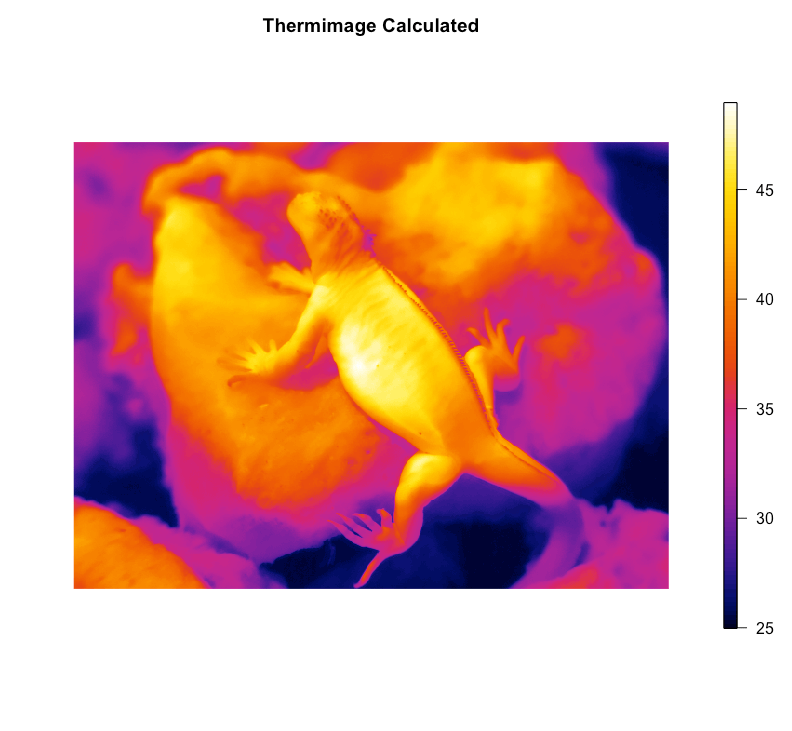
I’ve updated the Thermimage package.  The recent update includes calculations for modelling heat transfer from radiative and convective heat transfer from the animal to the environment, using temperatures captured from infrared thermal images.

The assumption is that the user already has temperature information captured and is simply using R to to analyse temperatures.  I am working on scripts for importing FLIR images into R but these are not yet included in Thermimage, since these scripts rely on external applications (EXIFTOOL) that have implementation issues in R.  (Edit: July 20, 2016, v 2.2.0 has a function for importing FLIR thermal jpgs for processing in R)

Thermimage is on Cran now at the following url:

https://cran.r-project.org/web/packages/Thermimage/index.html

Sample scripts on how to put the heat transfer equations to use are at:

https://github.com/gtatters/Thermimage/blob/master/heatcalc.R

I’ve also included a script to “test” the validity of the thermal image calculations where I convert the binary thermal image data into temperature:

https://github.com/gtatters/ThermimageCalibration/blob/master/ThermimageCheckCalculations.R

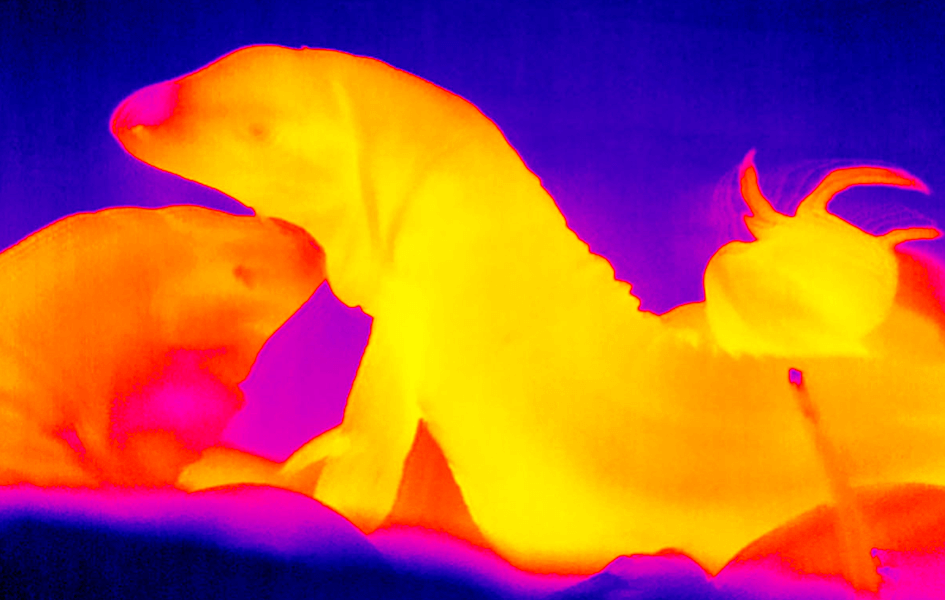
MarineIguana.png

Any issues with the code can be raised here:

https://github.com/gtatters/Thermimage/issues

Conference Season

It’s been a busy two weeks in the lab, courtesy of my hard working graduate students.  Susan, Justin and Anne presented their thesis research at the Ontario Ecology and Ethology Colloquium last week.  Here are some screen shots of their abstract titles.

oe3c-2016-final-program_may2oe3c-2016-final-program_may3

Then, this past week, the lab attended the Canadian Society of Zoologists conference to present our research.  Justin and Susan represented the lab work at Brock, while Cayleih Robertson (PhD student of Grant McClelland at McMaster) presented her work (a collaboration I’m happy to be part of).  Everyone gave excellent talks and appeared to enjoy the conference and workshops.

Susan Wang received an honourable mention for the CAS Lindsay Prize for best oral presentation in the Parasitism, Immunity, and Environment section. We’re all very proud of her!

JustinSusanCayleih

Finally, although Dimitri Skandalis left the lab a number of years ago, I was very pleased that Dimitri received the William S Hoar Award for best overall student presentation at the CSZ this year.    Here is is looking especially happy, as are his past and current supervisors (Left to Right: Darveau, Skandalis, Tattersall, Altschuler).

Dimitri and Supervisors.png