So, we’ve decided to hire the local mockingbird. Well, hire is a lose term. Like many student interns and volunteers, he is paid nothing. Science is, after all, a passion, and not a means to get rich. But we cannot exactly feed him peanuts either. Anyhow, here he is setting up our equipment in the field: 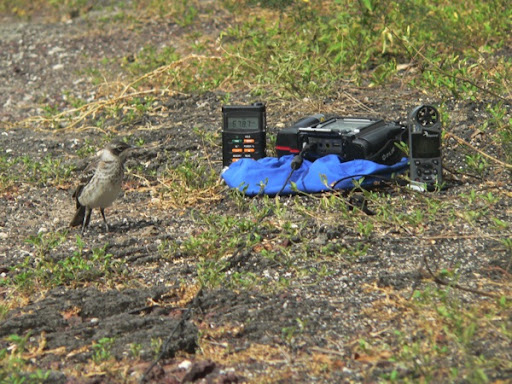
And inspecting the cables to make sure they are connected to the computer:

Looks like he even knows how to add an extension cable: 
If I had had an opportunity to volunteer as a student, I’d have jumped at the chance! I wonder if he knows about IP agreements and has assumptions of co-authorship…please don’t tell research services or HR that we have an unpaid intern who has not had his health and safety training.
Uncategorized
To kill a mockingbird? How could you!? Perhaps simply to film a mockingbird?
We have been making great strides in our ‘field thermography’ project here. Finches are in great abundance and even allow us to get close enough for imagery. There are, of course, numerous other animals interesting enough to take thermographs of, and some are even keen to help out!! The Galapagos Mockingbird here has been frequenting our field site and is very curious of our technology. So much so that here it is sat perched on my thermal camera while I stopped to take some weather readings: 
It is really quite adorable, although he likes to bully the other birds and chases the finches away from the camera. Not a very helpful field assistant.
Oh…some good news. I’ve just been invited to film some of the giant tortoises up close. I might actually get to do some tortoise Science!!
Hone your plant metabolism knowledge and Infrared Skills
Case note: Cactus plants are abundant here on Galapagos. Go back to your first year botany and see if you can explain why the cactus temperature is higher than other nearby plants.


Sorry, I cut the top off on the thermal image above. Hint: it should have something to do with Crassulacean (spelling? I have no spell check here!) Acid Metabolism.
What manner of creature?
Yesterday, we took one of the ever-present white toyota trucks that whiz around Puerto Ayora up to a potential field site. These trucks act as taxis and I wonder if shipment of toyotas fell off a shipping container in the pacific and washed up on shore in the Galapagos (much like most of the creatures here). Anyhow, scoping out the field site for potential finch sightings, we stumbled across this interesting creature.

I will allow the comments to see if you can guess as to what it is. Remember, there are no known venomous snakes in the Galapagos. This creature is about 5 inches long.
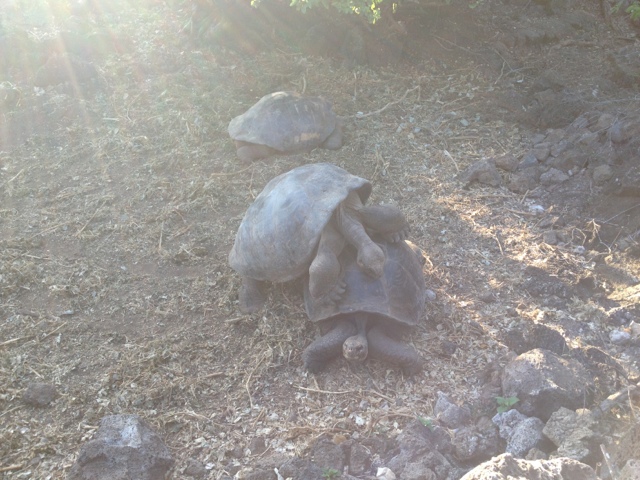
Galapagos Toroises at their finest
Our cabins at the station are located about 50 m away from the tortoise breeding program. Sometimes things can get a little heated
Btw still searching Internet. Currently borrowing from cafes in town
I wish I were an iguana!
Ok…We finally arrived at Charles Darwin Research Station. Long day yesterday and after many buses, dragging suitcases and equipment through the heat we arrived close to the station and park entrance. Only to find out that EVERYONE is at lunch. Including the iguanas.
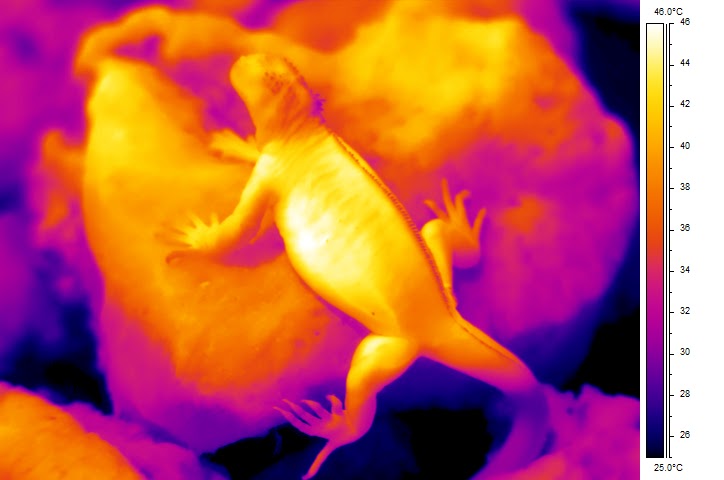
So, while waiting in the sun for the officials to come back and help us with our accommodation (etc.) I snapped a thermal image from the water.
Here is a marine iguana soaking up the sun’s rays. Skin temperatures of 45C. This is how I will be over the next month. Scorching and sunburnt!
Blog entries will be sporadic. I think I managed to upload this image because the whole island just left for lunch and so the internet isn’t swamped.
Anyhow! Enjoy!
Arrival in Ecuador!
Well, the first leg of the trip is over. We arrived in Guayaquil late Monday evening. I had no trouble with immigration, although I may have received a marriage proposal from the immigration officer. Or at least she warned me not to fall in love in (or with?) Ecuador.
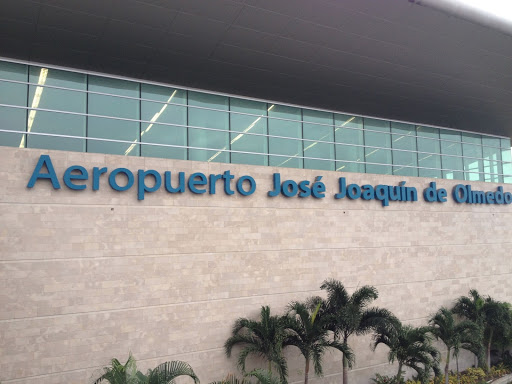
Our taxi driver/hotel seemed to be confused. We booked a hotel at the lovely Guayaquil Suites Hotel. Always be suspicious about something called ‘suites’. Lovely place once we arrived (sweating and hauling our equipment laden suitcases), but it looked more like someone’s apartment/spare rooms than a hotel!
Sorry for no photos. Internet connection here requires patience, which I seem to lack when the weather is hot and the sweat is pouring off me.
Departure to GPS imminent
Waiting for my flight to Galapagos. Departing in a couple of hours. Excited and slightly shocked that this is happening.
Will be in Puerto Ayora sometime tomorrow (16th April).
It’s official! We’re going to the Galapagos!!
It has been over a year in the making, and at times I was not sure it would happen at all, but we finally got our tickets to head to Galapagos. I am using this as an excuse perhaps to start putting some effort into this blog.
Here’s the context. Back in 2009, I published a paper on the role of the bill of the toucan as a ‘radiator of body heat’ (http://www.sciencemag.org/content/325/5939/468.abstract). Meanwhile, Russ Greenberg and his student/post-doc, Ray Danner were working on Song Sparrow ecology and bill size. After reading my paper and contacting me, we started sharing ideas and Russ began to develop questions examining how bills of his birds may be shaped by their environment (temperature, water availability).
Anyhow, long story short….this led to Russ and Ray collaborating with my lab via my student, Viviana Cadena who spent a couple of months in Ray’s lab working on heat loss parameters in song sparrows. (see below).

This work with sparrows showed that the bill in these birds can represent up to ~9% of resting body heat loss.
Last year, along with Russ, Ray and Viviana, we submitted a grant to the National Geographic Society to go to the Galapagos to test our research questions in Darwin’s Finches. I won’t go into those details yet, but perhaps future blogs will shed some light.
Anyhow, heading out on Monday and will be away for a month. Let’s hope we don’t have any trouble getting there!
For a summary of this work, here is a great blog from Jack Dumbacher.
On why I became a biologist
Earlier this week, I attended an ‘Interpretative reading’ competition at my nephew’s school. Needless to say, I would not be attending the competition if my nephew were not competing. 🙂
He chose to read Farley Mowat’s opening chapter to Never Cry Wolf. I would paste the chapter here, but likely be sued for copyright infringement, but suffice to say, Mowat’s eloquent introduction to how he became a biologist rings familiar. Fish or frog catching in local streams and bringing these animals home to examine is a common theme in many a biologist’s background. The same can be said for my own desire to be a biologist, and what I remind myself every day is that a certain portion of my job involves simply exploring the natural world much like a child would, with fascination but far less poking with sticks.
Oh, and my nephew…he won first place for his reading. Congratulations!!
 Tattersall Lab (TEMP)