Twists of fate and the hidden story of salamander abnormalities

A new paper has been accepted in the Canadian Journal of Zoology, resulting from Gloria Gao’s (Njal Rollinson’s lab at University of Toronto) hard work and based (in part) on the long-term study of the spotted salamanders at Bat Lake, Algonquin Park along with other field sites in Algonquin Park.

This study investigates the prevalence and fitness consequences of morphological abnormalities in Spotted Salamanders (Ambystoma maculatum) within an uncontaminated ecosystem in Algonquin Provincial Park, Canada. Over a 12-year period, the study found that abnormality rates ranged from 4.3% to 5.8% annually, aligning with baseline frequencies observed in other minimally impacted amphibian populations. Interestingly, despite expectations that abnormalities might reduce fitness, salamanders with abnormalities in this study displayed slightly higher body condition and significantly earlier arrival times at breeding sites—traits typically associated with high fitness. These results suggest a potential survivorship bias, where only individuals with favourable genetic or environmental factors survive to be observed, masking the true impact of abnormalities.

The study also highlights the importance of understanding abnormality rates in uncontaminated environments, as these can provide valuable baselines for comparison with more impacted habitats. It appears that Caudata (salamanders and newts) generally have a higher prevalence of abnormalities compared to Anura (frogs and toads), although the reasons for this remain speculative. The findings from this study underscore the complex relationship between abnormalities and fitness and emphasize the need for further research to explore how environmental factors influence these dynamics in amphibian populations.

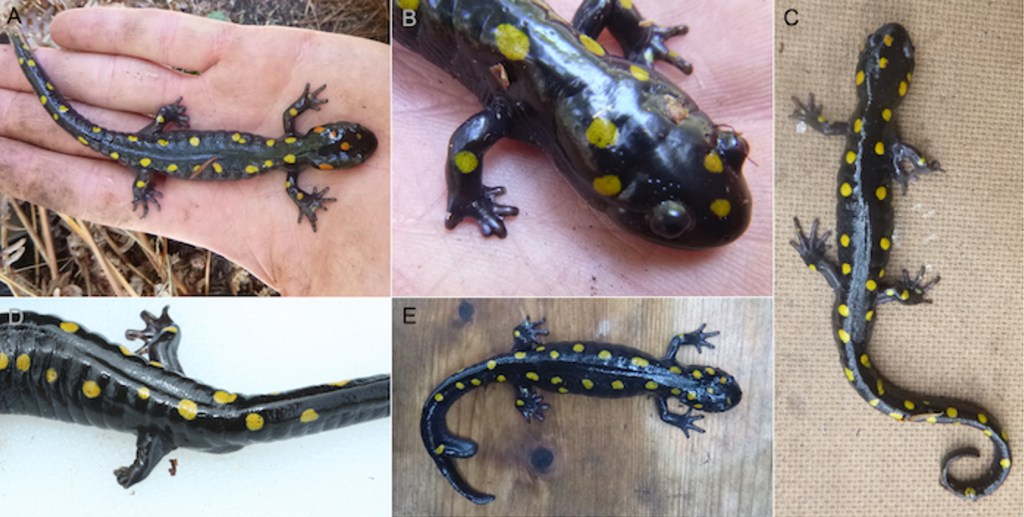
Examples of abnormalities observed among Spotted Salamanders at Bat Lake, Algonquin Provincial Park: A. polydactyly (additional phalanges) resulting from partial duplication of the hand on the right forelimb; B. partial syndactyly (fused digits) and abnormal arrangement of the right forelimb phalanges; C. polymelia (limb duplication) of the right forelimb; D. micromelia (proportionately small or short limb) of the left hindlimb demonstrating early stage regeneration following probable amputation; E. tail bifurcation.

Citation

Gao, GHY, Moldowan, PD, LeGros, DL, Sahar, M, Tattersall, GJ, and Rollinson, N. 2024. Frequency of adult amphibian abnormalities and consequences for traits related to fitness in an uncontaminated environment. Canadian Journal of Zoology, doi.org/10.1139/cjz-2024-0063.

Proofs are not yet available, but will update when they are.

Salamanders show inherent seasonal differences in thermal preference

Very pleased to have my PhD student, Danilo Giacometti’s paper accepted recently in Royal Open Science. This represents the culmination of over a year’s work carefully measuring temperature selection. He has a much better blog post here on the subject by Danilo Giacometti, but I’ll post the abstract and citation below.

Abstract

Temperature seasonality plays a pivotal role in shaping the thermal biology of ectotherms. However, we still have a limited understanding of how amphibians maintain thermal balance in the face of varying temperatures, especially in fossorial species. Due to thermal buffering underground, theory predicts relaxed selection pressure over thermoregulation in fossorial ectotherms. As a result, fossorial ectotherms typically show low thermoregulatory precision and low evidence of thermotactic behaviours in laboratory thermal gradients. Here, we evaluated how temperature selection (Tsel) and associated behaviours differed between seasons in the Spotted Salamander (Ambystoma maculatum). By comparing thermoregulatory parameters between the activity and overwintering seasons, we show that Amaculatum engages in active behavioural thermoregulation despite being fossorial. In both seasons, Tsel was consistently offset higher than prevailing thermal conditions. Thermoregulation differed between seasons (see table below), with salamanders having higher Tsel and showing greater evidence of thermophilic behaviours in the active compared to the overwintering season. Our study highlights that the combination of behavioural and thermal biology measurements is a necessary step to better understand the mechanisms that underlie body temperature control in amphibians. Ultimately, we provide a broader understanding of thermoregulation in the context of behavioural responses to seasonality in fossorial ectotherms.

Citation

Giacometti, D and Tattersall, GJ. 2024. Seasonal variation of behavioural thermoregulation in a fossorial salamander (Ambystoma maculatum). Royal Open Science, https://doi.org/10.1098/rsos.240537

Just how big is that bill?

Dr. Sara Ryding’s next thesis chapter just came out in the Journal of Avian Biology. Sara (co-supervised) just finished her PhD with Matt Symonds, Deakin University. Congratulations Sara!

Here is a summary of the study:

Unidimensional measurements for estimating bill size, like length and width, are commonly used in ecology and evolution, but can be criticised due to issues with repeatability and accuracy. Furthermore, formula-based estimates of bill surface area tend to assume uniform bill shapes across species, which is rarely the case. 3D surface scanning can potentially help overcome some such issues by collecting detailed external morphology and direct measurements of surface area, rather than composite estimates of size. Here, we evaluate the use of 3D surface scanners on avian museum specimens to test the repeatability of 3D-based measurements and compare these to traditional formula-based methods of estimating bill size from unidimensional measurements. Using 28 Australian bird species, we investigate inter-observer repeatability of surface area measurements from 3D surface scans. We then compare 3D-based size estimates to formula-based size estimates to infer the accuracy and precision of formula-based measurements of bill surface area. We find that morphometric measurements from 3D surface scans are highly repeatable between observers, without the need for extensive training, demonstrating an advantage over unidimensional measuring methods, like callipers. When comparing 3D-based measurements to formula-based estimates of bill surface area, most formulae for estimating size consistently underestimate surface area, and with considerable variation between species. Where 3D scanning is not possible, we find that a commonly used cone formula for estimating bill size is most precise across diverse bill shapes, therefore supporting its use in interspecific contexts. However, we find that incorporating an additional unidimensional measure of bill curvature into formulae improves the accuracy of the calculated area. Our results reveal the high potential for 3D surface scanners in avian morphometric research, especially for studies necessitating large sample sizes collected by multiple observers, and gives suggestions for formula-based approaches to estimate bill size.

Citation

Sara RydingGlenn J. TattersallMarcel KlaassenDavid J. WilkinsonMatthew R. E. Symonds 2024. Measuring avian bill size: comparing and evaluating 3D surface scanning with traditional size estimates in Australian birds. Journal of Avian Biology, 2024 e03248. https://doi.org/10.1111/jav.03248

Animal Behaviour Society Presentation

Melanie Denommé (PhD student in the lab) is attending the Animal Behaviour Society meeting today, presenting on her PhD research, entitled “Enclosure style preferences are influenced by experience in bearded dragons (Pogona vitticeps)“.

She shows some intriguing results about how early life exposure to different housing conditions alters subsequent preference tests for how bearded dragons interact with enrichments!

Curious Case of Self-Inflicted Injury in Bearded Dragons

A study from the lab has just been published on a rare behaviour in our bearded dragons.  Missing toes are a reasonably common observation in group housed lizards, with the usual explanation being hungry cage-mates attacking one another, perhaps confusing toes with food or perhaps simply as possible food. However, we report on something quite different here. Over a span of two years, Melanie Denommé (PhD candidate) meticulously observed the behaviour of P. vitticeps housed in laboratory settings and noted that on rare occasions, the lizards would bite their own toes!  We saw this in both juvenile and adult individuals, albeit infrequently. Interestingly, the behaviour occurred in the presence of various environmental conditions, including loose substrates, hot surfaces, and during periods of ecdysis (shedding of skin).

The self-directed toe-biting behaviour involves the lizard assuming a distinctive posture, often resembling a C-shape, before striking at its toes with its tongue. This behaviour, which closely resembles regular eating behaviour, typically lasts for less than a minute. When we saw a call for papers on rare behaviours and proposals for hypotheses for these behaviours from the journal In&Sights, we decided to submit our observations there, and experience the new, open access form of peer review. 

While the function of this behaviour remains unclear, we proposed several hypotheses to elucidate its purpose.

One hypothesis suggests that self-directed toe-biting may serve a grooming or cleaning function, aiding in the removal of loose particulate matter caught between the toes or facilitating ecdysis. However, evidence supporting this hypothesis is inconclusive, as the behaviour was not consistently associated with shedding cycles, and no instances of using the mouth for shedding have been observed in related lizard species.

Another hypothesis posits that self-directed toe-biting may be a maladaptive behaviour resulting from captivity-induced stress or discomfort. This hypothesis is supported by observations of the behaviour occurring after extensive basking or gaping, potentially indicating overheating or discomfort in the lizards. However, the exact stimuli triggering the behaviour remain unclear, and further research is needed to explore its underlying causes.

A third hypothesis suggests that self-directed toe-biting may be a form of self-injurious behaviour linked to perceived stress or neurological factors. While this hypothesis offers insights into potential behavioural abnormalities, no clear correlations between self-directed toe-biting and other stress-related behaviours were observed in the study population.

Throughout the study, we meticulously documented occurrences of self-directed toe-biting using time-lapse cameras. Despite its infrequent occurrence, the behaviour was noted in multiple individuals, suggesting that it may be a natural variation within the species rather than an isolated anomaly.

This study on self-directed toe-biting in captive Pogona vitticeps offers valuable insights into the complexities of animal behaviour and adaptation. By exploring potential hypotheses and documenting observations meticulously, we hope to encourage future research aimed at unravelling the mystery behind this intriguing behaviour and its significance to the lives of these fascinating reptiles.

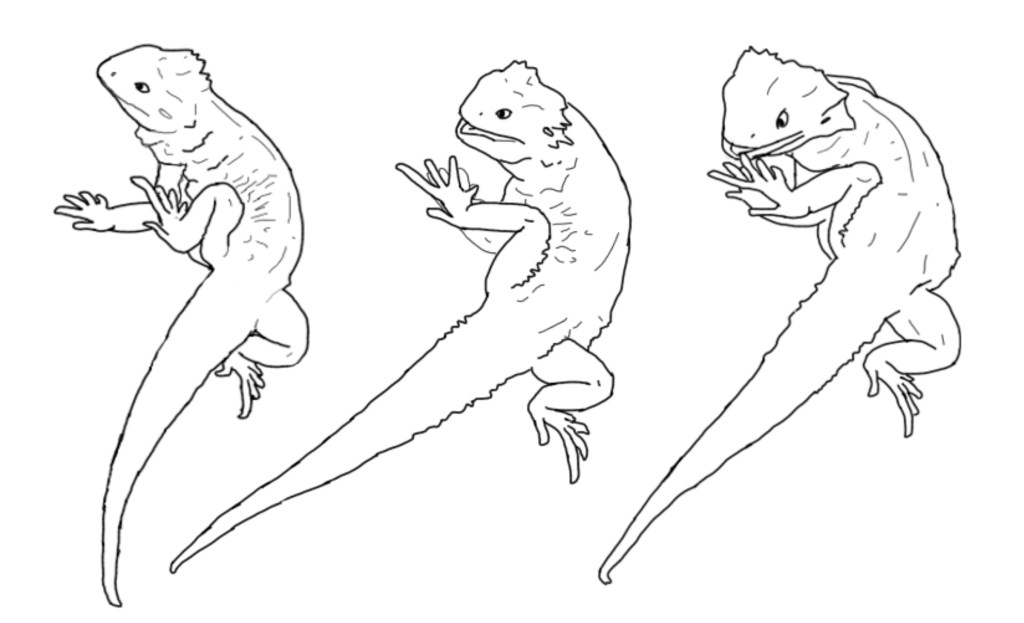
Illustration of the steps of self-directed toe-biting behaviour. The lizard begins by raising their leg close to their face, then may straighten the leg or curve the head towards the foot. The lizard may also bend their head down to meet their foot. Finally, leading with the tongue, the lizard strikes at their toes repeatedly. The behaviour ends when the foot returns to its original position

Citation

Denommé, M and Tattersall, GJ. 2024. Self-directed toe-biting in captive Pogona vitticeps. In&Vertebrates https://doi.org/10.52732/VOZL2285

Link to Paper

https://inandsight.science/journal/papers/65259e2f890bbf5b40a4ef45

Link to Video Demonstrating the Behaviour

https://doi.org/10.5683/SP3/JQ7UGP

 A time-lapse based video clip of Pogona vitticeps demonstrating toe-biting behaviour. Videos were generated from still images captures at 1 frame per second, with playback at 30 frames/second, so the behaviours are sped up ~30 times.

Bird limbs control heat loss better than bills

Our paper using field thermal imaging in Australian birds has just been published in Biology Letters. We demonstrate that bird limbs exert greater control over peripheral heat loss than bird bills. Here is a link to the study.

Abstract

Endotherms use their appendages—such as legs, tails, ears and bills—for thermoregulation by controlling blood flow to near-surface blood vessels, conserving heat when it is cold, and dissipating heat in hot conditions. Larger appendages allow greater heat dissipation, and appendage sizes vary latitudinally according to Allen’s rule. However, little is known about the relative importance of different appendages for thermoregulation. We investigate physiological control of heat loss via bird bills and legs using infrared thermography of wild birds. Our results demonstrate that birds are less able to regulate heat loss via their bills than their legs. In cold conditions, birds lower their leg surface temperature to below that of their plumage surface, retaining heat at their core. In warm conditions, birds increase their leg surface temperature to above that of their plumage surface, expelling heat. By contrast, bill surface temperature remains approximately 2°C warmer than the plumage surface, indicating consistent heat loss under almost all conditions. Poorer physiological control of heat loss via bird bills likely entails stronger selection for shorter bills in cold climates. This could explain why bird bills show stronger latitudinal size clines than bird legs, with implications for predicting shape-shifting responses to climate change.

Sample thermal images of study birds, showing the range of cool and warm limbs and bills. We captured images from 14 species of Australian birds at various environmental conditions to construct a probability of heat loss emanating from each appendage.
Image analysis involves dividing the thermal image into component parts and extracting temperatures from these regions of interest.
With thermal imaging, all body regions are strongly related to air temperature, so in any study employing thermography, accurate, real-time measurements of air temperature (and solar radiation) are required to make sense of the data.

In the paper, we incorporate biophysical modelling of the two, well vascularised appendages to estimate the actual heat flux from the appendage (incorporating solar radiation, wind speed, relative humidity measurements) and then simplify this down to a simple metric of whether the appendage was losing heat or not.

Citation

McQueen, A, Barnaby, R, Symonds, MRE, and Tattersall, GJ. 2023. Birds are better at regulating heat loss through their legs than their bills: implications for body shape evolution in response to climate. Biology Letters. 19: 20230373. https://doi.org/10.1098/rsbl.2023.0373

Acknowledgements

The data from this study were collected by A McQueen and R Barnaby. We thank Scott Rolph, Robin Sinclair, Robert Moore, Mike Weston and Chris Purnell for help with fieldwork, private landowners for access to properties and reviewers for their helpful feedback. We acknowledge the Wurundjeri, Bunurong, and Wadawurrung People as Traditional Owners of the land on which fieldwork was carried out.

Unearthing energetic mysteries: exploring metabolic rates in fossorial amphibians

The following is a guest blog by Danilo Giacometti, MSc.

Background

By living underground or in burrows, fossorial animals benefit from protection against predators and climatic buffering. This seclusion, however, may lead to increased exposure to low O2 (hypoxia) and high CO2 (hypercarbia) levels in burrows. Hypoxia and hypercarbia are well known to impact respiration and energetics in both endotherms and ectotherms. If exposure to hypoxic and hypercarbic conditions persist over the long term (i.e., across generations), natural selection should favour organisms with a blunted sensitivity to gas exchange limitations. As such, fossoriality has long been associated with energy conservation. Most of the evidence in favour of fossorial species having low energetic requirements comes from work in mammals. By studying the metabolism of rodents, McNab (1966) suggested that fossorial species had convergently evolved low metabolic rates compared to non-fossorial ones. McNab’s logic was straightforward: given an energetic stressor (i.e., hypoxia and hypercarbia), natural selection favoured a physiological adaptation (i.e., low metabolic rates) that would minimise O2 depletion and CO2 buildup.

Almost 20 years later, this hypothesis was extended to explain metabolic adaptations in squamate reptiles by Andrews & Pough (1985). Although other researchers attempted to elucidate whether fossoriality had impacted the metabolism of vertebrate ectotherms (e.g., Kamel & Gatten, 1983Ultsh & Anderson, 1988Withers, 1981), most studies were limited by a small number of species used in comparisons, lack of phylogenetic control, and improper consideration of body mass effects over metabolism. Perhaps the most important consideration in this context comes from Wang & Abe (1994), who called attention to the fact that the metabolism of vertebrate ectotherms is intrinsically lower than that of endotherms. Thus, a further reduction in metabolism driven solely by fossoriality would be evolutionarily unlikely given the limited energetic benefit. In this sense, the impact of fossoriality on the metabolic rates of vertebrate ectotherms has remained unclear.

What did we do?

With this in mind, we addressed whether fossorial amphibians were selected for lowered metabolic rates compared to non-fossorial and aquatic ones in a phylogenetic framework. Building from a compilation of amphibian metabolic rates found in Chapter 12 of Feder & Burggren (1992), we collated a dataset with information on metabolic rates, test temperature, body mass, latitude, lifestyle, and phylogenetic relatedness of 185 species of amphibians (Fig. 1). Details on our methodology, inclusion criteria, and analyses can be found in our manuscript.

Fig. 1. States of lifestyle (aquatic, fossorial, or non-fossorial) plotted along the tips of the phylogeny representing the relationship among the 185 species contained in our dataset. We obtained silhouettes of representatives of major amphibian families from PhyloPic’s public repository.

What did we find?

Thermal and body mass effects over metabolic rates

As expected, both test temperature and body mass explained differences in metabolism among species (Fig. 2). Metabolic rates increased with temperature; however, the thermal dependence of metabolism did not differ among lifestyles (Fig. 2A). Additionally, our results are in concert with the principle of metabolic scaling, as body mass was the primary determinant of metabolic rate variation after accounting for phylogenetic effects. In general, the larger the species, the higher its metabolic rate—once again, regardless of lifestyle (Fig. 2B). This finding fits in with the framework proposed by White et al. (2022), who argued that metabolic scaling is the outcome of optimised growth and reproduction. Considering that we found metabolism and body size to be inextricably correlated in amphibians, life history optimisation could be the mechanism behind our recovered pattern.

Fig. 2. A. Variation of predicted metabolic rates (logV̇O2) across test temperatures for the 185 species considered in this study. logV̇O2 increased with test temperature, as indicated by the red dots and their corresponding confidence limits (red bars). B. Phylogenetically controlled linear regression depicting the scaling between predicted logV̇O2 values and logBody Mass. The solid red line and grey shaded area indicate the predicted relationship between the two variables and the 95% confidence interval, respectively.

Unraveling the mysteries of fossoriality: potential roles of cutaneous breathing

Our results revealed that fossorial amphibians do not have lower metabolic rates compared to their non-fossorial and aquatic counterparts after controlling for body mass, temperature, and phylogenetic effects. We suggest that the low energetic requirements of amphibians, coupled with their efficient cutaneous and pulmonary respiration capabilities, may explain why fossoriality did not impinge on their metabolism. Preliminary work in caecilians showed that fossorial species can sustain energetic requirements solely through cutaneous breathing, suggesting increased reliance on skin breathing and enhanced control of bimodal breathing in this group (Smits & Flanagin, 1994). We suggest that further research into the blood respiratory properties and bimodal breathing capacities of fossorial versus non-fossorial amphibians should provide valuable insights into their energy-saving strategies.

Conclusion

Through a comprehensive comparative analysis, we bring to light the complex interplay of factors influencing the metabolism of amphibians. Our work emphasises the central role of body mass and temperature in determining metabolic rates and suggest the possibility that the unique respiratory physiology of amphibians may have contributed to offset the effects of fossoriality over energetics in this group. As research continues to unearth the mysteries of fossoriality, it promises to deepen our appreciation for the remarkable adaptations of these unique creatures living beneath the surface.

Our article will be freely available for eight weeks on initial publication. Read the full study here.

Citation

Giacometti, D and Tattersall, GJ. 2023. Putting the energetic‐savings hypothesis underground: fossoriality does not affect metabolic rates in amphibians. Evolutionary Ecology, In Press.

Acknowledgements

We thank Leonardo Servino for helping us obtain geographic coordinates for the species in our dataset. We also thank the two anonymous reviewers whose comments helped improve our manuscript. Research funding was provided by a Natural Sciences and Engineering Research Council of Canada Discovery Grant to GJT (RGPIN-2020-05089).

Hermit crabs going boldly into the sun

Long time in coming, but Phil Bartel’s Honours project was just accepted for publication in Behavioural Processes! We explored the influence of temperature on boldness, a personality trait, and more specifically the repeatability of these behaviours as a function of temperature.

Hermit crab (Coenobita clypeatus) walking on sun exposed sand (Belize).

Abstract to the study:

An animal’s boldness is generally considered to be influenced by genetic and developmental factors. However, abiotic factors such as temperature have profound effects on the physiology of ectothermic animals, and thus can influence the expression and measurement of this behavioural trait. We examined the relationship between temperature and behaviour in the Caribbean hermit crab (Coenobita clypeatus) using field and lab experiments. Crabs captured in the sun were bolder than crabs captured in the shade, even when measured at a common temperature, which led to bold crabs experiencing higher microhabitat temperatures. In laboratory housed conditions, crabs demonstrated highly repeatable boldness behaviours at all temperatures, and as temperature increased, the mean behavioural latencies decreased across all individuals. Bolder crabs do not seem to rely on an innately higher thermal preference, since there was no association between boldness behaviours and thermal preference in the laboratory.  Instead, bolder crabs seem to exploit more open, riskier habitats than shyer crabs. Our results highlight the complex interplay between physiological and ecological factors influencing the behaviour of a widespread and ecologically important ectothermic animal.

Influence of capture location on boldness related behaviour in Coenobita clypeatus showing that animals captured in sunnier locations exhibited bolder behaviours when tested at a common temperature.

For quick access to the paper (50 free clicks until September 2023):

https://authors.elsevier.com/a/1hR1o1LenMUgoK

Citation

Sakich, NB, Bartel, PC, Richards, MR, and Tattersall, GJ. 2023. Hot crabs with bold choices: temperature has little impact on behavioural repeatability in Caribbean hermit crabs. Behavioural Processes, 210: 104916. https://doi.org/10.1016/j.beproc.2023.104916

Acknowledgements

This project emerged from years of running Animal Behaviour labs with 3rd year undergraduates, teaching them about animal personalities, so we wish to the numerous cohorts of Animal Behaviour students who explored hermit crab behaviours with us, and inspired the project.