If you have ever walked through a goldenrod field, you have probably noticed the round, marble-sized galls on the stems. Each one houses a single larva of the goldenrod gall fly (Eurosta solidaginis), which coaxes the plant into building it a home that is both its pantry and fortress. But a ball of living plant tissue, sealed on all sides, should also be a hard place to get oxygen.
Our new paper in the Journal of Experimental Biology asks a simple question: do these galls become hypoxic, and if so, can the larva cope? We combined larval respirometry, a biophysical model of oxygen diffusion through the gall’s concentric tissue layers, and direct oxygen measurements from field galls over two seasons. Larvae were only moderately tolerant of low oxygen (critical Po₂ around 10.8 kPa), and the model predicted a brief window of hypoxia early in gall growth. After that, the gall’s cortex dries out, becoming less metabolically active and more permeable to oxygen, which restores near-atmospheric levels inside. Oddly enough, the plant’s own developmental program, not any special adaptation by the larva, seems to do most of the work. The two field seasons told different stories, though. In 2011, a cold spring and an early-summer drought produced smaller galls, slower cortex maturation, and much more severe hypoxia than the model predicted. This is a reminder that “year effects” can be biology worth studying, not just noise to average away.
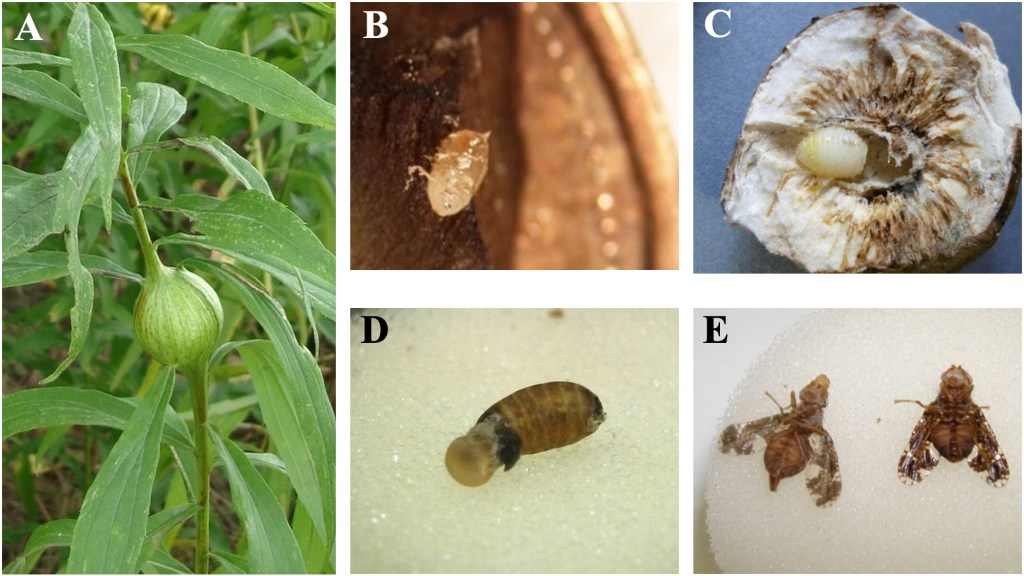
This paper is also proof that it is never too late to publish good work. The data were collected in 2010 and 2011 as part of Qian Long’s MSc thesis, defended in 2012, and they have waited patiently for over a decade to see the light of day. Qian deserves enormous credit for his hard work and dedication. He built a flow-through respirometer and a custom diffusion chamber for gall tissue, threaded fibre-optic oxygen probes into hundreds of galls in the field, and tracked gall and larval development through two very different summers. Revisiting the dataset with modern Bayesian tools let us do justice to what he collected, and I am delighted to finally see it in print. And for anyone sitting on a thesis chapter that never quite made it out the door, maybe this will serve as some encouragement!
For a related “Inside JEB” write-up about the article see: https://doi.org/10.1242/jeb.253624
Citation
Long, Q and Tattersall, GJ. 2026. Living on borrowed oxygen in the goldenrod gall fly (Eurosta solidaginis). Journal of Experimental Biology. 229, jeb253204. https://doi.org/10.1242/jeb.253204

