Ecology, size and thermal windows

Birds use their bare, uninsulated bills and legs as “thermal windows”. In hot conditions they send more blood to the surface to shed heat, and in the cold they restrict that blood flow. In a new study in Functional Ecology, co-led by Sara Ryding and Alexandra McQueen with Matt Symonds and Marcel Klaassen at Deakin University, we brought together two strands of our earlier joint work: thermal imaging of how birds control appendage heat loss, and museum-based measurements of how bird body shape has changed over the past century. Using infrared thermography of 12 wild bird species around Melbourne, Australia, we estimated how strongly each species adjusts its bill and leg surface temperatures as air temperature changes.

Species differed considerably in how they use their bills. Larger species, species with relatively longer bills, and water-associated species such as coots, ducks and gulls all showed greater control of heat loss through the bill. Water-associated species also had better control through their legs, probably because they face large convective heat loss while wading and swimming. Leg control was otherwise fairly similar across species, which may reflect the efficient countercurrent heat exchangers that most birds already have in their legs.

Sample thermal images from McQueen et al 2023: https://doi.org/10.1098/rsbl.2023.0373

We then asked a species-specific question. Are the birds with this “enhanced” control over appendage heat loss also the ones that have been shape-shifting the most, increasing bill size over time as the climate warms? Using 3D scans and measurements of museum specimens collected between 1885 and 2014 for seven of these species, we found that bill size changes varied a lot among species. However, we found no convincing evidence that species with better vasomotor control of their bills have shown larger increases in bill size. There was a weak trend in that direction, but the sample of species is small, so this is best seen as a first step in linking thermal physiology to morphological change. A useful next step would be comparing species from more contrasting climates, such as arid, tropical or migratory birds, which would tell us whether physiological flexibility and morphological change act as alternative routes, or as complementary ones, for coping with a warming world.

Citation

Ryding, S, McQueen, A, Tattersall, GJ, Klaassen, M, Barnaby, R, Sims, I, and Symonds, MRE. 2026. Size, morphology and ecology explain interspecific differences in the use of bird bills and legs as thermal windows. Functional Ecology. https://doi.org/10.1111/1365-2435.70499
Living on Borrowed Oxygen (and Borrowed Time)

If you have ever walked through a goldenrod field, you have probably noticed the round, marble-sized galls on the stems. Each one houses a single larva of the goldenrod gall fly (Eurosta solidaginis), which coaxes the plant into building it a home that is both its pantry and fortress. But a ball of living plant tissue, sealed on all sides, should also be a hard place to get oxygen.

Our new paper in the Journal of Experimental Biology asks a simple question: do these galls become hypoxic, and if so, can the larva cope? We combined larval respirometry, a biophysical model of oxygen diffusion through the gall’s concentric tissue layers, and direct oxygen measurements from field galls over two seasons. Larvae were only moderately tolerant of low oxygen (critical Po₂ around 10.8 kPa), and the model predicted a brief window of hypoxia early in gall growth. After that, the gall’s cortex dries out, becoming less metabolically active and more permeable to oxygen, which restores near-atmospheric levels inside. Oddly enough, the plant’s own developmental program, not any special adaptation by the larva, seems to do most of the work. The two field seasons told different stories, though. In 2011, a cold spring and an early-summer drought produced smaller galls, slower cortex maturation, and much more severe hypoxia than the model predicted. This is a reminder that “year effects” can be biology worth studying, not just noise to average away.

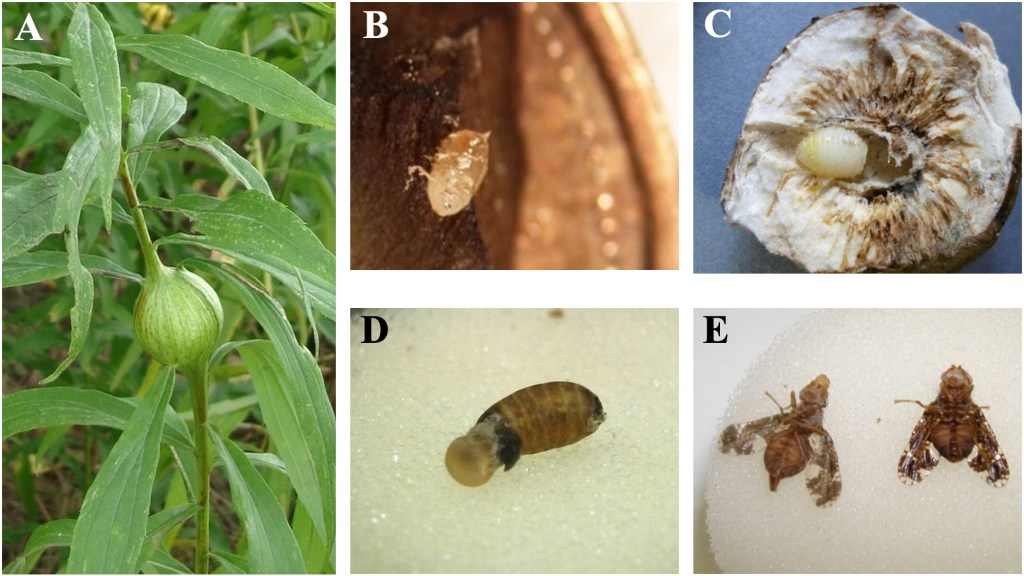
Major stages in the Eurosta solidaginis life cycle. A: Gall on a Solidago stem. B: Young larva extracted from its gall, placed on a Canadian one-cent coin (diameter 19.05 mm) as scale reference. C: Mature larva in a dead gall. The exit tunnel has been excavated. D: Adult emerging from pupa, with ptilinum still inflated. E: Ventral view of adult female (left) and male (right), distinguishable by the female’s ovipositor at the end of the abdomen. All photos were taken during this study.

This paper is also proof that it is never too late to publish good work. The data were collected in 2010 and 2011 as part of Qian Long’s MSc thesis, defended in 2012, and they have waited patiently for over a decade to see the light of day. Qian deserves enormous credit for his hard work and dedication. He built a flow-through respirometer and a custom diffusion chamber for gall tissue, threaded fibre-optic oxygen probes into hundreds of galls in the field, and tracked gall and larval development through two very different summers. Revisiting the dataset with modern Bayesian tools let us do justice to what he collected, and I am delighted to finally see it in print. And for anyone sitting on a thesis chapter that never quite made it out the door, maybe this will serve as some encouragement!

For a related “Inside JEB” write-up about the article see: https://doi.org/10.1242/jeb.253624

Citation

Long, Q and Tattersall, GJ. 2026. Living on borrowed oxygen in the goldenrod gall fly (Eurosta solidaginis). Journal of Experimental Biology. 229, jeb253204. https://doi.org/10.1242/jeb.253204