Relationship between “naturalistic enclosures” and lizard welfare not so simple

Bearded dragons (Pogona vitticeps) have become one of the most popular pet reptiles and in many cases are contributing to research as well. But as their popularity has soared, so too has the need to better understand what these lizards actually need to live well in captivity. Our latest study, recently published in PLOS ONE, examines whether giving bearded dragons more “naturalistic” resources within their enclosures actually improves their well-being. These enclosures included features like climbing structures, loose substrate, and multiple hiding spots, compared to standard setups with only basic furnishings. We expected these more complex spaces to help the lizards behave more naturally and experience less stress. While the naturalistic enclosures did offer better thermal variety (important for ectothermic animals like reptiles), we were surprised to find that they did not have a clear effect on how active the lizards were, how they used their space, or how often they showed signs of stress or relaxation. 

Interestingly, only female lizards housed long-term in naturalistic enclosures showed lower levels of physiological stress (measured through ratios of white blood cells), suggesting that any benefits might be subtle or sex-specific. 

Overall, our findings show that simply adding complexity to an enclosure isn’t enough to guarantee better welfare. It may be that lizards don’t perceive naturalistic and standard enclosures as very different, or that enclosure size matters more than what’s in it. For reptile owners and researchers alike, the take-home message is this: meaningful welfare improvements require us to think beyond aesthetics or what human caretakers assume is “good” or “natural”—we need to constantly evaluate our efforts and ask the animals themselves what they think. 

The study is open access and available at the following link: https://doi.org/10.1371/journal.pone.0322682

Citation

Denommé, M and Tattersall, GJ. 2025. Influence of enclosure design on the behaviour and welfare of Pogona vitticeps. PLoS One 20(6): e0322682 https://doi.org/10.1371/journal.pone.0322682

A bearded dragon on top of cork bark. Photo credit Dr. Danilo Giacometti.

Unlocking the Motivations of Repetitive Behaviours in Reptiles

Our latest study (https://doi.org/10.1016/j.applanim.2024.106484) sheds light on a perplexing behaviour seen in captive reptiles, namely their interactions with barriers (IWB), a form of repetitive behaviour akin to pacing in mammals. As part of her PhD research, Melanie Denommé investigated the motivations behind IWB in bearded dragons (Pogona vitticeps; Figure 1) over a three year period, and formally tested whether it stems from a “desire” to escape their enclosures.

Figure 1. Photo of a bearded dragon interacting with a barrier (called glass surfing sometimes if the lizard moves back and forth across the transparent barrier, although reptiles may do this on non-transparent barriers as well).

Our findings revealed a strong preference for performing IWB near the front barrier of their environment (Figure 2), the only known escape route; even when half of it was obscured; they also direct more of their behaviour toward the transparent part of the front barrier. Interestingly, IWB was 15 times more likely to occur around the time when lizards defecated, supporting an argument that these behaviours may be driven by escape-related motivations, at least with respect the need to find suitable defecation areas.  However, no clear link was found between IWB and anticipation of feeding, suggesting species-specific differences in how repetitive behaviours are triggered. Despite these results, lizards would still exhibit IWB with non-transparent barriers (Figure 2), suggesting that escape is not the exclusive explanation for these repetitive behaviours.

Figure 2. Results from multiple rounds of home cage observations of barrier wall interaction (minutes per day). Bearded dragons interacted more with the front barrier (that is, the barrier from which escape could occur), although still exhibited IWB (interacting with barriers) along the other 3 walls of the enclosure.

Seasonal and sex-related patterns offered further nuance. Contrary to expectations, female lizards performed IWB more during spring, while males showed consistent levels year-round. This might reflect frustrated breeding-season motivations, as females in the wild often roam widely in search of mates, a behaviour restricted in captivity. These findings emphasize the complex interplay between natural instincts and captive conditions, highlighting the importance of tailoring environments to better meet the needs of individual animals. By understanding these behaviours and using an evidence-based approach, we can deepen insights into the diverse causes of repetitive behaviours across species and thereby improve captive reptile welfare.

Note that the actual levels of IWB seen were low throughout the study, with numerous animals never performing the behaviour. There appear to be individual differences in the expression of IWB.

Citation

Denommé, M and Tattersall, GJ. 2025. Investigating the motivations of repetitive barrier interactions in Pogona vitticeps. Applied Animal Behaviour Science, 283: 106484. https://doi.org/10.1016/j.applanim.2024.106484

Shrinking Shorebirds & How Climate is Reshaping Them

Shorebirds across Australia are experiencing notable changes in size and shape, offering a vivid example of climate change’s impact on wildlife. In a recent publication in Ecology Letters (McQueen et al), using comprehensive 46-year study involving over 200,000 observations across 25 species we show widespread declines in body size (“shrinking”) and concurrent increases in bill length (“shape-shifting”). These shifts appear to align with thermal adaptation, where smaller bodies and elongated bills would help dissipate heat more effectively in warmer environments. However, we also found that smaller species exhibited the most pronounced changes, while long-distance migratory species showed weaker trends, possibly due to physical constraints needed for efficient flight over vast distances.

Interestingly, while bill lengths have generally increased over time, they shortened following exposure to recent hot summers, hinting at complex evolutionary trade-offs between short-term vs. long-term climatic fluctuations.  We suggest these changes may reflect not only adaptations for thermoregulation but also responses to nutritional stress or other environmental pressures. These findings emphasize the dual role of climate change as both a selective force and a stressor. As global temperatures continue to rise, understanding these morphological changes is crucial for predicting their effects on species survival and the ecosystems they inhabit.

Field sites and climate information for northern and southern Australian shorebird populations. A and B show locations where shorebirds have been sampled by members of the VWSG and AWSG (black circles) and nearby Australian Bureau of Meteorology weather stations with summer temperature data from 1970-2021 (blue triangles); colour scale shows average summer daily maximum temperatures (December-February). 

To read more about the study, it in open access below. 

Citation

A. McQueen, M. Klaassen, G. J. Tattersall, S. Ryding, Victorian Wader Study Group, Australasian Wader Studies Group, R. Atkinson, R. Jessop, C. J. Hassell, M. Christie, A. Fröhlich, M. R. E. Symonds. 2024. Shorebirds are shrinking and shape-shifting: declining dody size and lengthening bills in the past half-century. Ecology Letters. 27:e14513. https://doi.org/10.1111/ele.14513

When Salamanders Surface: Understanding the Secrets Behind Spotted Salamander Overwintering Emergence

Amphibians have long fascinated researchers due to their unique life cycles and environmental sensitivities, but many aspects about the biology of fossorial (i.e., burrowing) species remain shrouded in mystery. Fossorial amphibians like the Spotted Salamander (Ambystoma maculatum) spend most of their lives underground, emerging to the surface only briefly to breed or forage. In our latest paper, we address some of the intrinsic and extrinsic factors that may trigger emergence from overwintering by evaluating the interplay between temperature, gravity, and innate migratory cues over salamander behaviour.

Our study focussed on the role of soil temperature inversion—a seasonal shift where surface soils warm faster than deeper layers—in signalling salamanders to leave their winter refuges and begin their overland journey to breeding ponds. Using a vertical thermal gradient in the lab, we examined how salamanders responded to temperature cues at different depths and whether their activity levels changed with temperature shifts that mimicked soil temperature inversion. Our findings suggested that salamanders are not only tolerant of a wide thermal range but are also displaying a circannual phenomenon known as “migration restlessness”. Migration restlessness is characterised by a surge in movement often seen in animals preparing to migrate. Coupled with negative geotaxis, a tendency to move upward against gravity, this restless behaviour may explain why salamanders begin their spring migration at just the right moment, maximising their chances of reproductive success while avoiding the dangers of emerging too early and potentially freezing.

Representation of soil temperature inversion in the forest surrounding Bat Lake, Algonquin Provincial Park, ON, Canada, from where the spotted salamanders were collected.

A. Schematic of the vertical thermal gradient used to assess the effects of thermal inversion and gravity on salamander behaviour. Thermal image of the active (B) and overwintering (C) thermal gradients used in the study. The thermal gradient was always kept at a 45º angle relative to the horizontal axis, imitating underground burrows. 

Sped-up time-lapse of a male Ambystoma maculatum tested within the active thermal gradient. Frames were taken every 30 s, for a total of 18 h of experiment (20 frames/sec).

For a link to an interview with the first author ECR, Danilo Giacometti, please see the following link.

For a link to the paper, please see the citation below.

Citation

Giacometti D., Moldowan P. D., Tattersall G. J.; Ups and downs of fossorial life: migration restlessness and geotaxis may explain overwintering emergence in the Spotted Salamander. J Exp Biol 2024; jeb.249319. doi: https://doi.org/10.1242/jeb.249319

Blog Author: Danilo Giacometti

Shape-Shifting in the Face of Climate Change: The Long and the Short of How Australian Birds Are Adapting

As global temperatures rise, animals are facing mounting pressure to adapt, and Australian birds are no exception. Our recent research (from Sara Ryding’s PhD research) has examined over 5,000 museum specimens, representing 78 bird species across Australia, revealing clear changes in their body and appendage sizes. These changes are aligned with two well-known ecological principles: Bergmann’s rule, which predicts smaller body sizes in warmer climates in endotherms, and Allen’s rule, which argues that animals (namely endotherms) will develop larger appendages to regulate body heat. Consistent with these theories, our study found that birds are experiencing a long-term decrease in body size, particularly in absolute wing length, while their appendages, such as bills and tarsi (leg bones), are getting larger relative to their bodies. This phenomenon, often referred to as “shape-shifting,” is a widespread response to the increasing temperatures driven by climate change.

Interestingly, our research also highlights a more complex picture when it comes to short-term responses. While long-term trends show a clear increase in appendage size to aid thermoregulation, birds displayed smaller appendages in the years following hotter temperatures. This suggests that while birds are gradually adapting to rising temperatures over time, short-term weather events may create different selection pressures that affect growth and development. Factors like food availability and reproductive challenges could contribute to these opposing trends. This study underscores the intricate balance between long-term evolutionary changes and the immediate pressures exerted by fluctuating environmental conditions, offering critical insights into how birds—and potentially other animals—might continue to respond to our rapidly changing world.

For a link to the study, please see the citation below.

Citation

Ryding, McQueen, A, Klaassen, M, Tattersall, GJ, and Symonds, MRE. 2024. Long- and short-term responses to climate change in body and appendage size of diverse Australian birds. Global Change Biology, 30:e17517. https://doi.org/10.1111/gcb.17517

Twists of fate and the hidden story of salamander abnormalities

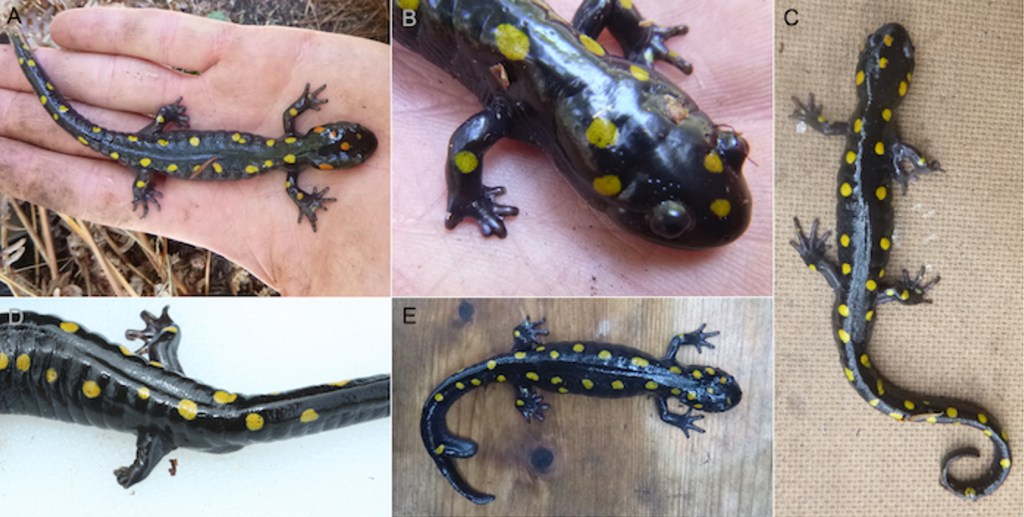
A new paper has been accepted in the Canadian Journal of Zoology, resulting from Gloria Gao’s (Njal Rollinson’s lab at University of Toronto) hard work and based (in part) on the long-term study of the spotted salamanders at Bat Lake, Algonquin Park along with other field sites in Algonquin Park.

This study investigates the prevalence and fitness consequences of morphological abnormalities in Spotted Salamanders (Ambystoma maculatum) within an uncontaminated ecosystem in Algonquin Provincial Park, Canada. Over a 12-year period, the study found that abnormality rates ranged from 4.3% to 5.8% annually, aligning with baseline frequencies observed in other minimally impacted amphibian populations. Interestingly, despite expectations that abnormalities might reduce fitness, salamanders with abnormalities in this study displayed slightly higher body condition and significantly earlier arrival times at breeding sites—traits typically associated with high fitness. These results suggest a potential survivorship bias, where only individuals with favourable genetic or environmental factors survive to be observed, masking the true impact of abnormalities.

The study also highlights the importance of understanding abnormality rates in uncontaminated environments, as these can provide valuable baselines for comparison with more impacted habitats. It appears that Caudata (salamanders and newts) generally have a higher prevalence of abnormalities compared to Anura (frogs and toads), although the reasons for this remain speculative. The findings from this study underscore the complex relationship between abnormalities and fitness and emphasize the need for further research to explore how environmental factors influence these dynamics in amphibian populations.

Examples of abnormalities observed among Spotted Salamanders at Bat Lake, Algonquin Provincial Park: A. polydactyly (additional phalanges) resulting from partial duplication of the hand on the right forelimb; B. partial syndactyly (fused digits) and abnormal arrangement of the right forelimb phalanges; C. polymelia (limb duplication) of the right forelimb; D. micromelia (proportionately small or short limb) of the left hindlimb demonstrating early stage regeneration following probable amputation; E. tail bifurcation.

Citation

Gao, GHY, Moldowan, PD, LeGros, DL, Sahar, M, Tattersall, GJ, and Rollinson, N. 2024. Frequency of adult amphibian abnormalities and consequences for traits related to fitness in an uncontaminated environment. Canadian Journal of Zoology, doi.org/10.1139/cjz-2024-0063.

Proofs are not yet available, but will update when they are.