Birds use their bare, uninsulated bills and legs as “thermal windows”. In hot conditions they send more blood to the surface to shed heat, and in the cold they restrict that blood flow. In a new study in Functional Ecology, co-led by Sara Ryding and Alexandra McQueen with Matt Symonds and Marcel Klaassen at Deakin University, we brought together two strands of our earlier joint work: thermal imaging of how birds control appendage heat loss, and museum-based measurements of how bird body shape has changed over the past century. Using infrared thermography of 12 wild bird species around Melbourne, Australia, we estimated how strongly each species adjusts its bill and leg surface temperatures as air temperature changes.
Species differed considerably in how they use their bills. Larger species, species with relatively longer bills, and water-associated species such as coots, ducks and gulls all showed greater control of heat loss through the bill. Water-associated species also had better control through their legs, probably because they face large convective heat loss while wading and swimming. Leg control was otherwise fairly similar across species, which may reflect the efficient countercurrent heat exchangers that most birds already have in their legs.
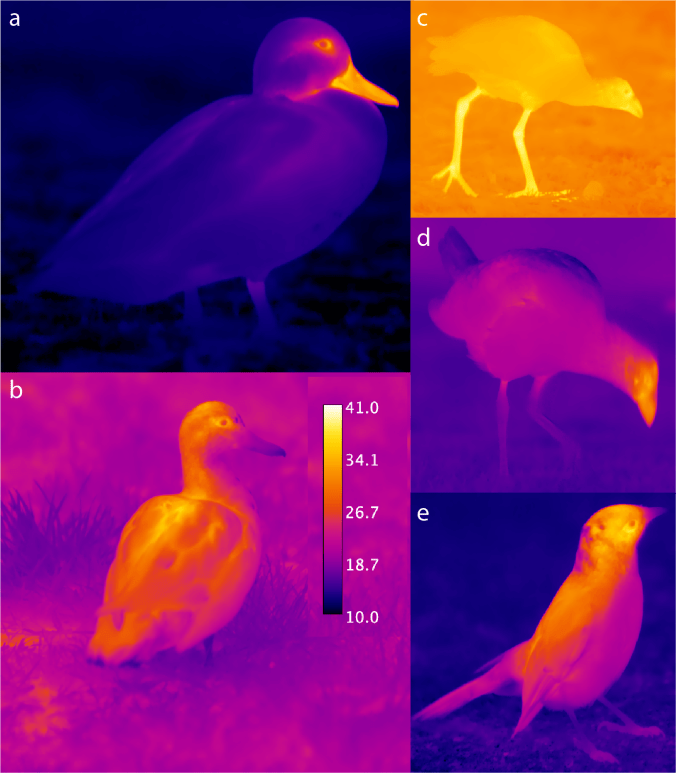
We then asked a species-specific question. Are the birds with this “enhanced” control over appendage heat loss also the ones that have been shape-shifting the most, increasing bill size over time as the climate warms? Using 3D scans and measurements of museum specimens collected between 1885 and 2014 for seven of these species, we found that bill size changes varied a lot among species. However, we found no convincing evidence that species with better vasomotor control of their bills have shown larger increases in bill size. There was a weak trend in that direction, but the sample of species is small, so this is best seen as a first step in linking thermal physiology to morphological change. A useful next step would be comparing species from more contrasting climates, such as arid, tropical or migratory birds, which would tell us whether physiological flexibility and morphological change act as alternative routes, or as complementary ones, for coping with a warming world.
Citation
Ryding, S, McQueen, A, Tattersall, GJ, Klaassen, M, Barnaby, R, Sims, I, and Symonds, MRE. 2026. Size, morphology and ecology explain interspecific differences in the use of bird bills and legs as thermal windows. Functional Ecology. https://doi.org/10.1111/1365-2435.70499

