We’re excited to share the publication of a new paper in Ecography, led by PhD candidate Sara Ryding (Deakin University, collaboration with Matt Symonds Lab), which explores how climate change may be reshaping the morphology of migratory shorebirds. Using an incredibly extensive dataset of nearly 19,000 juvenile birds across 11 species sampled over 43 years, Sara investigated whether warming temperatures are causing changes in relative wing length, a trait thought to play a role in thermoregulation. Interestingly, while juvenile shorebirds migrating to tropical northern Australia exhibited a consistent increase in relative wing length over time, no such trend was observed in their temperate southern counterparts.
Crucially, the study found no evidence that these morphological changes are driven by developmental temperatures at the breeding grounds, suggesting that these changes are unlikely to be short-term plastic responses. Instead, they may reflect long-term, potentially evolutionary responses to the environmental conditions experienced at non-breeding sites. This work highlights how subtle, climate-linked changes in body shape (e.g. “shape-shifting”) may be occurring unevenly across populations, depending on local climatic pressures.
Congratulations to Sara on this significant contribution to our understanding of how wildlife is adapting to our changing planet.
Citation
Ryding, S, McQueen, A, Symonds, MRE, Tattersall, GJ, Victorian Wader Study Group, Australasian Wader Studies Group, Rogers, DI, Atkinson, R, Jessop, R, Hassell, CJ, Christie, M, Ross, TA, and Klassen, M. 2025. Shape-shifting in relative wing length of juvenile shorebirds: no evidence of developmental temperatures driving morphological changes. Ecography, 2025: e07801. doi: 10.1002/ecog.07801
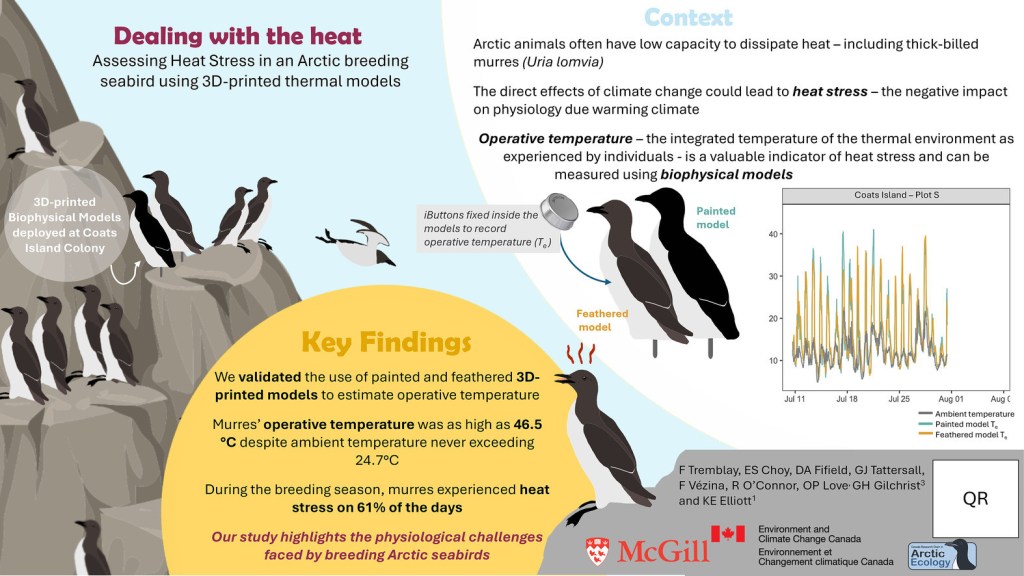
As the Arctic warms at an alarming pace, we’re learning that even cold-adapted species like the thick-billed murre aren’t immune to rising temperatures. This latest study, led by Fred Tremblay from Dr. Kyle Elliot’s lab at McGill adds to the growing understanding that cliff-nesting seabirds are experiencing heat stress far despite ambient air temperatures rarely exceeding 25°C. Using custom 3D-printed murre models painted to mimic the birds’ plumage, we measured “operative temperatures” (the actual heat experienced by an animal) on Coats Island, Nunavut. These operative temperatures soared as high as 46.5°C due to solar radiation and other environmental factors. In fact, murres faced heat stress conditions on 61% of summer breeding days, which can lead to significant water loss and physiological strain.
This work highlights the impact of climate change on Arctic wildlife and illustrates the value of biophysical modelling and how important it is to consider more than air temperature measurements in macroecology/macrophysiology (see https://doi.org/10.1111/1365-2656.12818 and https://doi.org/10.1002/ece3.5721).
These models, in combination with infrared thermal imaging, offer a non-invasive and cost-effective way to measure real-world thermal conditions, paving the way for better predictions of species vulnerability. With males incubating eggs during the hottest parts of the day, this heat stress isn’t just theoretical. It could shift breeding success, survival rates, and long-term population dynamics. These type of studies demonstrate the importance of microclimates in assessing the threats facing Arctic fauna and animals around the world.
Example thermal image of biophysical models and live thick-billed murres in the breeding colony at Coats Island, Nunavut, Canada. For each model and murres where at least 1/3 of the back is visible, the back area is indicated by the white perimeter with associated mean back temperature to the right.Graphical abstract of the study
For access to the study please follow the link in the citation below.
Citation
Tremblay F, Choy ES, Fifield DA, Tattersall GJ, Vézina F, O’Connor R, Love OP, Gilchrist GH, Elliott KH. 2025. Dealing with the heat: Assessing heat stress in an Arctic seabird using 3D-printed thermal models. Comp Biochem Physiol A Mol Integr Physiol. 306: 111880. https://doi.org/10.1016/j.cbpa.2025.111880
Ectotherms from highly seasonal habitats often exhibit remarkable physiological plasticity, which allows them to balanceand adjust energy and water budgets in the face of fluctuating climatic conditions. Yet, fossorial (i.e., underground-dwelling) ectotherms are thought to experience attenuated climatic variability underground, raising the question: do fossorial ectotherms also display seasonal adjustments in key physiological functions?
In our recent publication, we investigated how seasonal acclimation (spring vs. autumn) affected energy expenditure and water loss in the spotted salamander. By measuring standard metabolic rates (SMR) and rates of evaporative water loss (EWL), we aimed to disentangle acute (i.e., exposure to test temperatures) from prolonged (i.e., seasonal acclimation) effects.
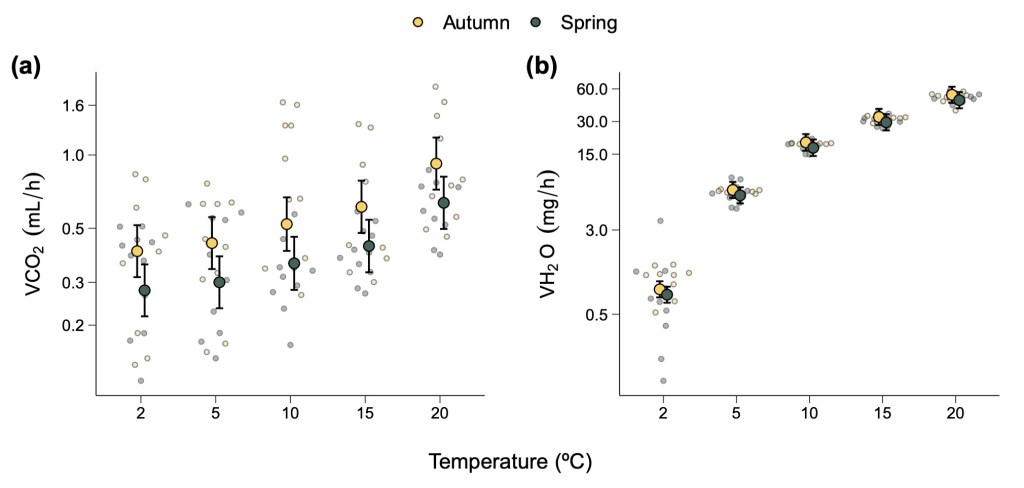
The effect of temperature over log-transformed rates of carbon dioxide (logV̇CO2) and water vapour production (logV̇H2O) in Ambystoma maculatum between the autumn and spring.
We found that increases in temperature led to increases in both SMR and EWL, demonstrating that fossorial salamanders also experience acute physiological costs when warmed. Salamanders had lower SMR in the spring, which may be beneficial in the context of overwintering emergence and breeding. In contrast, sustaining higher SMR in the autumn may allow salamanders to forage aboveground to replenish energy stores in preparation for the winter. EWL was stable between seasons, suggesting that salamanders may be more reliant on behavioural instead of physiological adjustments to manage water loss throughout the year. Together, our findings challenge the assumption that fossorial ectotherms are largely insulated from environmental fluctuations by virtue of living underground.
Giacometti, D, and Tattersall, GJ. 2025. Seasonal plasticity in the thermal sensitivity of metabolism but not water loss in a fossorial ectotherm. Oecologia. 207: 67. https://doi.org/10.1007/s00442-025-05711-6
Shorebirds across Australia are experiencing notable changes in size and shape, offering a vivid example of climate change’s impact on wildlife. In a recent publication in Ecology Letters (McQueen et al), using comprehensive 46-year study involving over 200,000 observations across 25 species we show widespread declines in body size (“shrinking”) and concurrent increases in bill length (“shape-shifting”). These shifts appear to align with thermal adaptation, where smaller bodies and elongated bills would help dissipate heat more effectively in warmer environments. However, we also found that smaller species exhibited the most pronounced changes, while long-distance migratory species showed weaker trends, possibly due to physical constraints needed for efficient flight over vast distances.
Interestingly, while bill lengths have generally increased over time, they shortened following exposure to recent hot summers, hinting at complex evolutionary trade-offs between short-term vs. long-term climatic fluctuations. We suggest these changes may reflect not only adaptations for thermoregulation but also responses to nutritional stress or other environmental pressures. These findings emphasize the dual role of climate change as both a selective force and a stressor. As global temperatures continue to rise, understanding these morphological changes is crucial for predicting their effects on species survival and the ecosystems they inhabit.
Field sites and climate information for northern and southern Australian shorebird populations. A and B show locations where shorebirds have been sampled by members of the VWSG and AWSG (black circles) and nearby Australian Bureau of Meteorology weather stations with summer temperature data from 1970-2021 (blue triangles); colour scale shows average summer daily maximum temperatures (December-February).
To read more about the study, it in open access below.
Citation
A. McQueen, M. Klaassen, G. J. Tattersall, S. Ryding, Victorian Wader Study Group, Australasian Wader Studies Group, R. Atkinson, R. Jessop, C. J. Hassell, M. Christie, A. Fröhlich, M. R. E. Symonds. 2024. Shorebirds are shrinking and shape-shifting: declining dody size and lengthening bills in the past half-century.Ecology Letters. 27:e14513. https://doi.org/10.1111/ele.14513
As global temperatures rise, animals are facing mounting pressure to adapt, and Australian birds are no exception. Our recent research (from Sara Ryding’s PhD research) has examined over 5,000 museum specimens, representing 78 bird species across Australia, revealing clear changes in their body and appendage sizes. These changes are aligned with two well-known ecological principles: Bergmann’s rule, which predicts smaller body sizes in warmer climates in endotherms, and Allen’s rule, which argues that animals (namely endotherms) will develop larger appendages to regulate body heat. Consistent with these theories, our study found that birds are experiencing a long-term decrease in body size, particularly in absolute wing length, while their appendages, such as bills and tarsi (leg bones), are getting larger relative to their bodies. This phenomenon, often referred to as “shape-shifting,” is a widespread response to the increasing temperatures driven by climate change.
Interestingly, our research also highlights a more complex picture when it comes to short-term responses. While long-term trends show a clear increase in appendage size to aid thermoregulation, birds displayed smaller appendages in the years following hotter temperatures. This suggests that while birds are gradually adapting to rising temperatures over time, short-term weather events may create different selection pressures that affect growth and development. Factors like food availability and reproductive challenges could contribute to these opposing trends. This study underscores the intricate balance between long-term evolutionary changes and the immediate pressures exerted by fluctuating environmental conditions, offering critical insights into how birds—and potentially other animals—might continue to respond to our rapidly changing world.
For a link to the study, please see the citation below.
Citation
Ryding, McQueen, A, Klaassen, M, Tattersall, GJ, and Symonds, MRE. 2024. Long- and short-term responses to climate change in body and appendage size of diverse Australian birds. Global Change Biology, 30:e17517. https://doi.org/10.1111/gcb.17517
Bergmann’s and Allen’s rules state that endotherms should be larger and have shorter appendages in cooler climates. However, the drivers of these rules are not clear. Both rules could be explained by adaptation for improved thermoregulation, including plastic responses to temperature in early life.
Our study has just been published in Nature Communications here:
Non-thermal explanations are also plausible as climate impacts other factors that influence size and shape, including starvation risk, predation risk, and foraging ecology. In this study, we assess the potential drivers of Bergmann’s and Allen’s rules in 30 shorebird species using extensive field data (>200,000 observations). We show birds in hot, tropical northern Australia have longer bills and smaller bodies than conspecifics in temperate, southern Australia, conforming with both ecogeographical rules.
Heat map of Australia, including the sample sites where morphological data from >30 species of shorebirds were used.
This pattern is consistent across ecologically diverse species, including migratory birds that spend early life in the Arctic. Our findings best support the hypothesis that thermoregulatory adaptation to warm climates drives latitudinal patterns in shorebird size and shape.
Acknowledgements
Dr. Alexandra McQueen (Post-Doc at Deakin University) did most of the work on this manuscript. The Victorian Wader Study Group and the Australasian Water Studies Group were responsible for the 46 years worth of data collected that made this study possible. My thanks to Matt Symonds and Marcel Dekker for including me in this study, a result made possible from an Australian Research Council Discovery Grant.
Citation
McQueen A, Klaassen M, Tattersall GJ, Atkinson R, Jessop R, Hassell CJ, Christie M; Victorian Wader Study Group; Australasian Wader Studies Group, Symonds MRE. 2022. Thermal adaptation best explains Bergmann’s and Allen’s Rules across ecologically diverse shorebirds. Nat Commun13, 4727. https://doi.org/10.1038/s41467-022-32108-3
Congratulations to Patrick Moldowan for our publication in Global Change Biology on “Climate associated decline of body condition in a fossorial salamander”.
Abstract of the study below:
Temperate ectotherms have responded to recent environmental change, likely due to the direct and indirect effects of temperature on key life cycle events. Yet, a substantial number of ectotherms are fossorial, spending the vast majority of their lives in subterranean microhabitats that are assumed to be buffered against environmental change.
Here, we examine whether seasonal climatic conditions influence body condition (a measure of general health and vigor), reproductive output, and breeding phenology in a northern population of fossorial salamander (Spotted Salamander, Ambystoma maculatum). We found that breeding body condition declined over a 12-year monitoring period (2008–2019) with warmer summer and autumn temperatures at least partly responsible for the observed decline in body condition.
Our findings are consistent with the hypothesis that elevated metabolism drives the negative associa- tion between temperature and condition. Population-level reproduction, assessed via egg mass counts, showed high interannual variation and was weakly influenced by autumn temperatures. Salamander breeding phenology was strongly correlated with lake ice melt but showed no long-term temporal trend (1986–2019).
Climatic warming in the region, which has been and is forecasted to be strongest in the summer and autumn, is predicted to lead to a 5%–27% decline in salamander body condition under realistic near-future climate scenarios. Although the subterranean environment offers a thermal buffer, the observed decline in condition and relatively strong effect of summer temperature on body condition suggest that fossorial salamanders are sensitive to the effects of a warming climate.
Given the diversity of fossorial taxa, heightened attention to the vulnerability of subterranean microhabitat refugia and their inhabitants is warranted amid global climatic change.
This study resulted from the PhD research of Patrick Moldowan, working with Dr. Njal Rollinson (U of Toronto) and myself. The research emanated from a long-term monitoring project called BLISS (https://tattersalllab.com/bliss/) that was initiated at various times in the past, with an objective to monitor mole salamanders (Spotted Salamanders, Ambystoma maculatum) in a pristine environment, for potential changes over time in population, phenology, reproductive output, and morphology.
I first met the Bat Lake salamanders in 1993, being introduced to the field site by a generous Dr. James Bogart who trusted me enough to leave me alone for 4 months to conduct research on an NSERC USRA project. I really want to thank Jim for sending me to this place where the field site captured the imagination, was a retreat from the urban life, and a crash course in wildlife ecology.
Moldowan, PD, Tattersall, GJ, and Rollinson, N. 2021. “Climate associated decline of body condition in a fossorial salamander”. Global Change Biology. http://doi.org/10.1111/gcb.15766
Acknowledgements
Many thanks to all the folks at the Algonquin Wildlife Research Station for support over the years and to all the Salamanderers who took part in BLISS: DL LeGros, SP Boyle, O Butty, JWD Connoy, D Crawford, EA Francis, G H-Y Gao, N Hrynko, JA Leivesley, DI Mullin, S Paiva, D Ravenhearst, C Rouleau, M Terebiznik, H Vleck, L Warma, SJ Kell and T Wynia. There are so many others who have helped out over the years, and we hope we have acknowledged all their assistance in the paper acknowledgements!
At long last, resulting from herculean efforts of a number of former students, our paper is published. Out today in Royal Society Open Science, our paper entitled: “Hydrogen sulfide exposure reduces thermal set point in zebrafish” represents the efforts of two honours students (JC Shaw and CD Dobell) and the writing and analytical skills of a great PDF and colleague (DA Skandalis).
Here is a link to the study and full citation:
Skandalis DA, Dobell CD, Shaw JC, Tattersall GJ. 2020 Hydrogen sulfide exposure reduces thermal set point in zebrafish. R. Soc. Open Sci. 7: 200416.
We tested whether dissolved H2S in the water will alter thermal preference. Previously, work in mice has suggested that mice could be induced to adopt a “hibernation-like” state, although there was some doubt (in the literature) as to whether H2S signalled a change in thermoregulatory state or simply acted as a metabolic inhibitor. By testing this in zebrafish, we could test formally whether they prefer cooler temperatures with H2S exposure, and they did. Not only did they choose to cool down, but they continued to make thermoregulatory decisions, swimming back and forth between cool and warmer water, suggesting they are still making thermoregulatory decisions and not simply caught in the cold water. So…yeah, complicated. H2S might induce a behavioural anapyrexia (a lowered thermal set-point). We discuss the potential environmental and neurophysiological context in the paper for those interested. The rotten egg reference is to the smell of H2S gas.
To conduct this study, we used a system built by Brock University’s Technical Services and employed in our research lab that allows us to track fish in a two chamber thermal shuttle box:
Schematic of the Shuttle Box System (see Figure S1 in the paper).
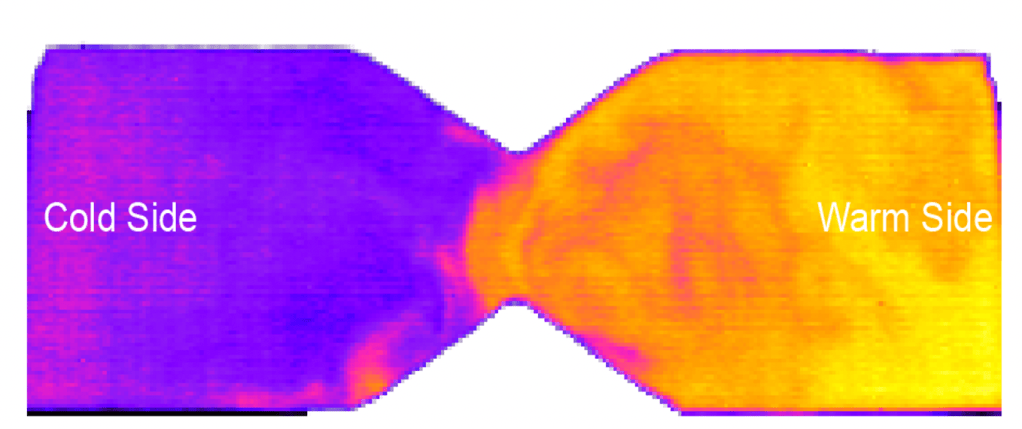
This setup allows us to heat and cool a tank and track the fish’s choices over time. Here is a thermal image depicting an earlier version of the shuttle box (correcting the spill over of warm-water in the centre can be corrected using baffles and a circular chamber system, but I haven’t taken a new picture with the thermal camera during the pandemic lockdown):
There was some considerable interest in developing H2S as a therapeutic to put mammals and/or tissues/organs into a suspended state. It is intriguing that animals like zebrafish that can behaviourally regulate body temperature continue to do so under this exposure. Anaprexic stategies are commonly seen in ectotherms and perhaps by hijacking an innate signalling system, H2S evokes this response.
When he left the lab to write up his thesis, he was but the learner…now, HE is the Master.
Congratulations, Justin Bridgeman for a successful defence! Justin’s thesis earlier today was on “Behavioural thermoregulation and escape behaviour in the round goby”.
Thanks to the selfless efforts of the committee members (Dr. Gaynor Spencer, Dr. Liette Vasseur, and Dr. Patricia Wright), external examiner (Dr. Dennis Higgs, U Windsor), and committee chair (Dr. Cheryl McCormick).
Thank to all the lab mates for supporting Justin and welcoming him back for his brief visit.
All the best in the future Justin! We look forward to the manuscripts…and for a place to crash when we visit you in Halifax! 😉
Please consider applying for this PhD Opportunity in Australia to work with my colleague, Dr Matthew Symonds on Shape-Shifting Birds.
This research forms part of an ARC Discovery Project (PI: Symonds; CI: Klassen & Tattersall) whose goal is to determine whether changes in body shape are an evolutionary response to climate change. Endothermic animals (such as birds) have a range of adaptations for dealing with the temperatures they experience. One such adaptation is body shape: birds in warmer climates tend to have large extremities (bills and legs), increasing their surface area and enabling loss of excess heat. Adaptations to climate (and hence climate change) can occur quickly, and there is evidence of significant increases in bird extremities in recent years – a novel potential consequence of climate change. Whether this represents an evolutionary response to climate change is unknown, nor do we know what characteristics make specific bird species liable to respond to climate change in this way, or what the likely consequences of such responses are.
The student will undertake an extensive comparative analysis of Australian birds, designed to identify a) which bird species are showing changes in body shape (bill and leg morphology); b) what ecological (life- history, behaviour, habitat) factors determine such responses; c) whether these changes relate to fitness/survival and d) whether such changes are linked to long-term populations trends in Australian birds.
The project will involve extensive work in Australian museum collections, measuring bird morphology using traditional and modern (3D-scanning) techniques. There is also a strong analytical component, involving use of long-term field data on Australian bird species as well as phylogenetic comparative analysis of large-scale ecological data sets for Australian birds.
Please send an application letter, together with your CV, to Dr Matthew Symonds (matthew.symonds@deakin.edu.au).
Further information can be found in our review papers:
Symonds, MRE and Tattersall, GJ. 2010. Geographical variation in bill size across bird species provides evidence for Allen’s rule.American Naturalist. 176: 188-197.
Tattersall, GJ, Arnaout, B, and Symonds, MRE. 2017. The evolution of the avian bill as a thermoregulatory organ. Biological Reviews 92: 1630-1656. doi:10.1111/brv.12299






 Tattersall Lab (TEMP)