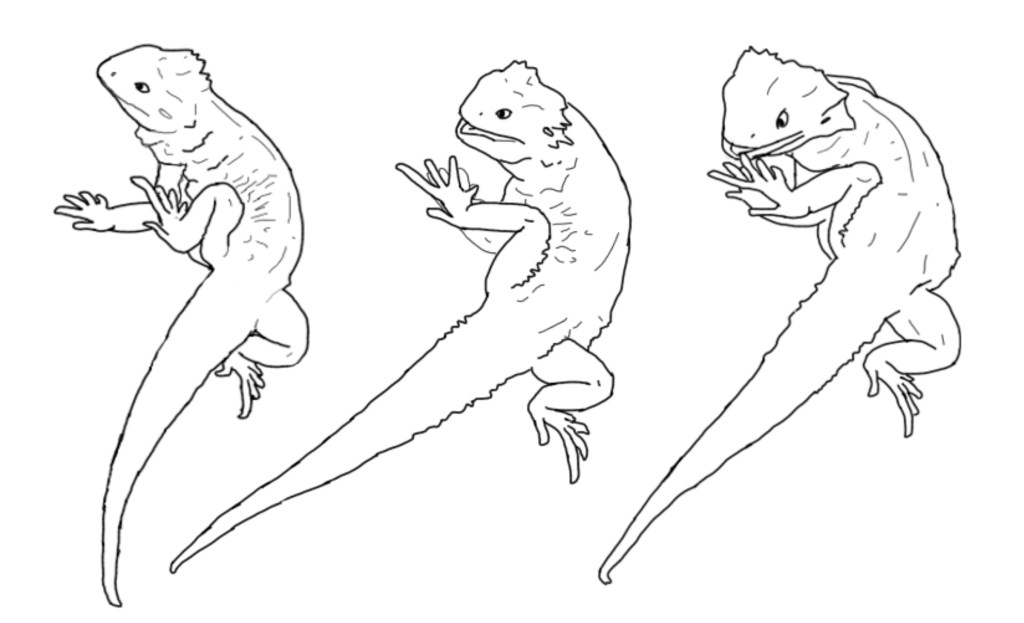
A study from the lab has just been published on a rare behaviour in our bearded dragons. Missing toes are a reasonably common observation in group housed lizards, with the usual explanation being hungry cage-mates attacking one another, perhaps confusing toes with food or perhaps simply as possible food. However, we report on something quite different here. Over a span of two years, Melanie Denommé (PhD candidate) meticulously observed the behaviour of P. vitticeps housed in laboratory settings and noted that on rare occasions, the lizards would bite their own toes! We saw this in both juvenile and adult individuals, albeit infrequently. Interestingly, the behaviour occurred in the presence of various environmental conditions, including loose substrates, hot surfaces, and during periods of ecdysis (shedding of skin).
The self-directed toe-biting behaviour involves the lizard assuming a distinctive posture, often resembling a C-shape, before striking at its toes with its tongue. This behaviour, which closely resembles regular eating behaviour, typically lasts for less than a minute. When we saw a call for papers on rare behaviours and proposals for hypotheses for these behaviours from the journal In&Sights, we decided to submit our observations there, and experience the new, open access form of peer review.
While the function of this behaviour remains unclear, we proposed several hypotheses to elucidate its purpose.
One hypothesis suggests that self-directed toe-biting may serve a grooming or cleaning function, aiding in the removal of loose particulate matter caught between the toes or facilitating ecdysis. However, evidence supporting this hypothesis is inconclusive, as the behaviour was not consistently associated with shedding cycles, and no instances of using the mouth for shedding have been observed in related lizard species.
Another hypothesis posits that self-directed toe-biting may be a maladaptive behaviour resulting from captivity-induced stress or discomfort. This hypothesis is supported by observations of the behaviour occurring after extensive basking or gaping, potentially indicating overheating or discomfort in the lizards. However, the exact stimuli triggering the behaviour remain unclear, and further research is needed to explore its underlying causes.
A third hypothesis suggests that self-directed toe-biting may be a form of self-injurious behaviour linked to perceived stress or neurological factors. While this hypothesis offers insights into potential behavioural abnormalities, no clear correlations between self-directed toe-biting and other stress-related behaviours were observed in the study population.
Throughout the study, we meticulously documented occurrences of self-directed toe-biting using time-lapse cameras. Despite its infrequent occurrence, the behaviour was noted in multiple individuals, suggesting that it may be a natural variation within the species rather than an isolated anomaly.
This study on self-directed toe-biting in captive Pogona vitticeps offers valuable insights into the complexities of animal behaviour and adaptation. By exploring potential hypotheses and documenting observations meticulously, we hope to encourage future research aimed at unravelling the mystery behind this intriguing behaviour and its significance to the lives of these fascinating reptiles.
Citation
Denommé, M and Tattersall, GJ. 2024. Self-directed toe-biting in captive Pogona vitticeps. In&Vertebrates https://doi.org/10.52732/VOZL2285
Link to Paper
https://inandsight.science/journal/papers/65259e2f890bbf5b40a4ef45
Link to Video Demonstrating the Behaviour
https://doi.org/10.5683/SP3/JQ7UGP


 Tattersall Lab (TEMP)