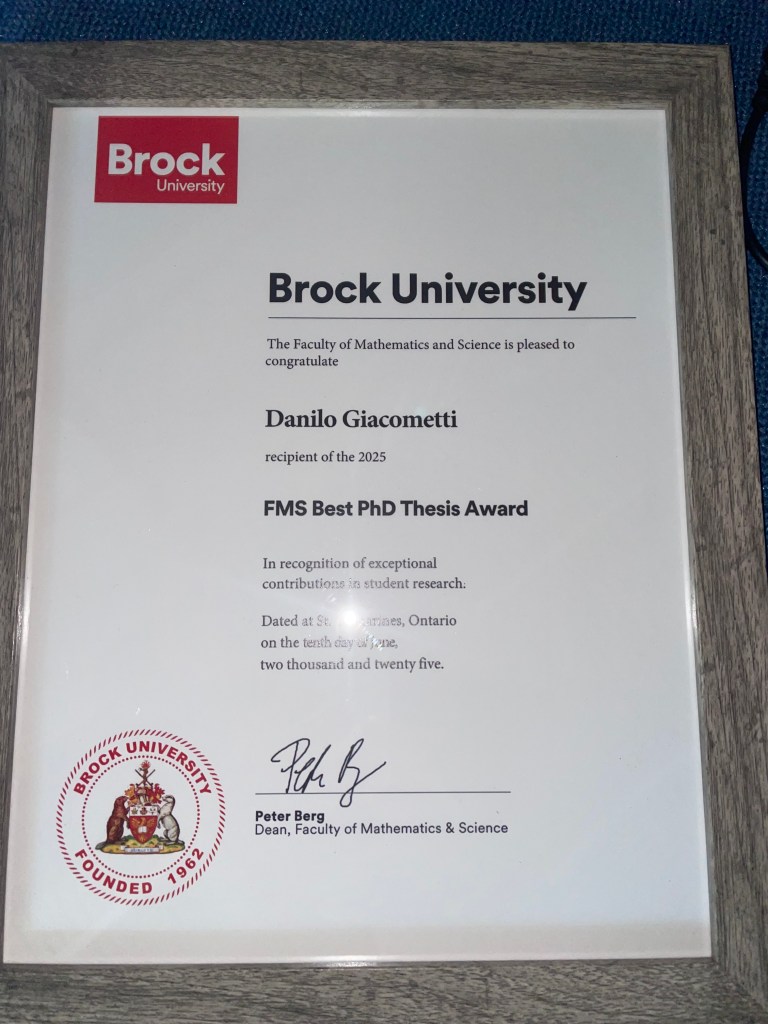
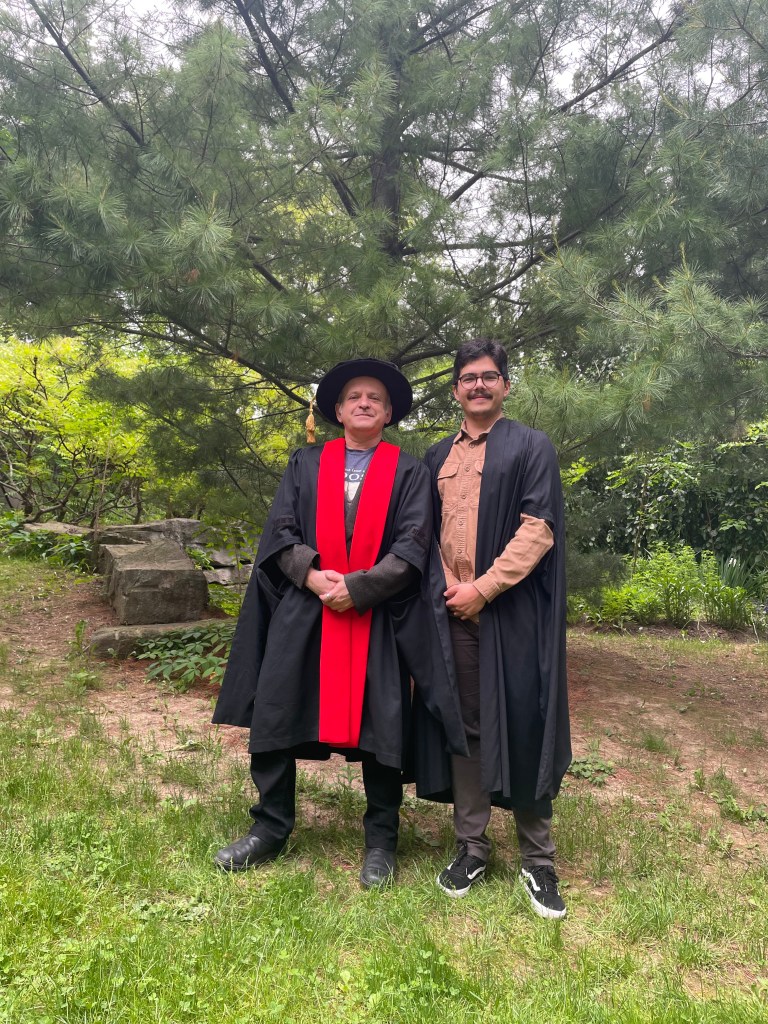
Congratulations Dr. Danilo Giacometti! The Faculty of Mathematics and Sciences at Brock has awarded you the FMS Best PhD Thesis Award. A supervisor could not be prouder!
News and Events Relevant to the Lab
Congratulations Dr. Danilo Giacometti! The Faculty of Mathematics and Sciences at Brock has awarded you the FMS Best PhD Thesis Award. A supervisor could not be prouder!
Bearded dragons (Pogona vitticeps) have become one of the most popular pet reptiles and in many cases are contributing to research as well. But as their popularity has soared, so too has the need to better understand what these lizards actually need to live well in captivity. Our latest study, recently published in PLOS ONE, examines whether giving bearded dragons more “naturalistic” resources within their enclosures actually improves their well-being. These enclosures included features like climbing structures, loose substrate, and multiple hiding spots, compared to standard setups with only basic furnishings. We expected these more complex spaces to help the lizards behave more naturally and experience less stress. While the naturalistic enclosures did offer better thermal variety (important for ectothermic animals like reptiles), we were surprised to find that they did not have a clear effect on how active the lizards were, how they used their space, or how often they showed signs of stress or relaxation.
Interestingly, only female lizards housed long-term in naturalistic enclosures showed lower levels of physiological stress (measured through ratios of white blood cells), suggesting that any benefits might be subtle or sex-specific.
Overall, our findings show that simply adding complexity to an enclosure isn’t enough to guarantee better welfare. It may be that lizards don’t perceive naturalistic and standard enclosures as very different, or that enclosure size matters more than what’s in it. For reptile owners and researchers alike, the take-home message is this: meaningful welfare improvements require us to think beyond aesthetics or what human caretakers assume is “good” or “natural”—we need to constantly evaluate our efforts and ask the animals themselves what they think.
The study is open access and available at the following link: https://doi.org/10.1371/journal.pone.0322682
Citation
Denommé, M and Tattersall, GJ. 2025. Influence of enclosure design on the behaviour and welfare of Pogona vitticeps. PLoS One 20(6): e0322682 https://doi.org/10.1371/journal.pone.0322682

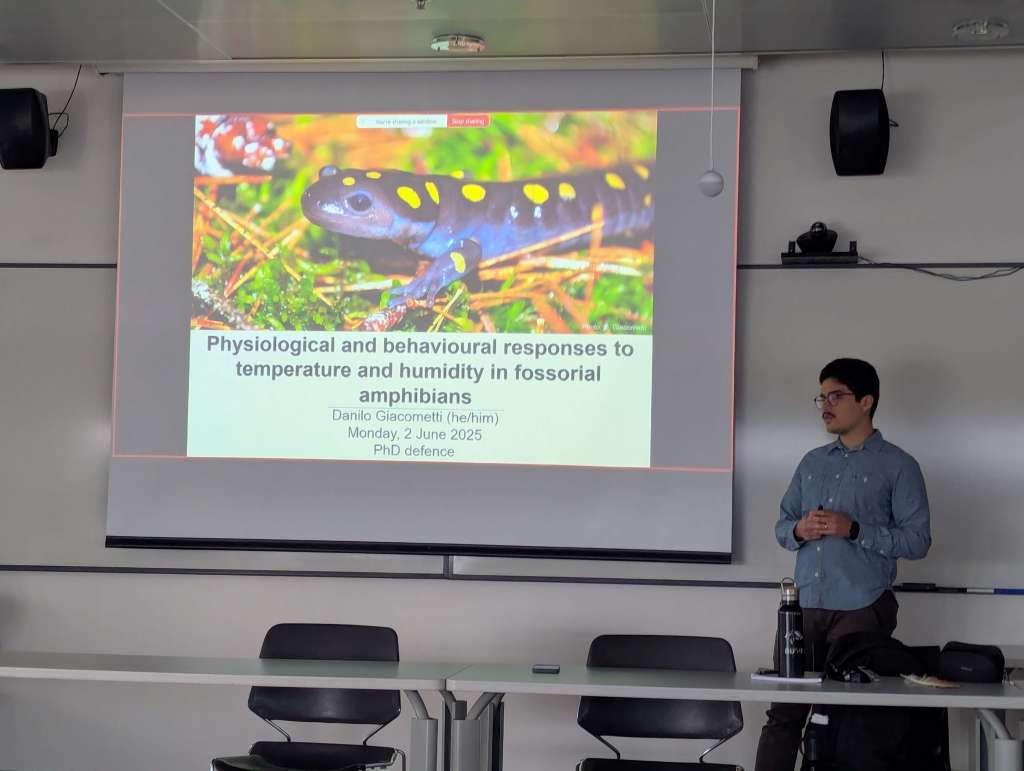
I am really proud to congratulate Dr. Danilo Giacometti for his successful PhD Defence! The thesis entitled “Physiological and behavioural responses to temperature and humidity in fossorial amphibians” was defended today in front of his examining committee: Dr. Don Miles (External, Ohio University), Dr. Toby Mündel (External within Brock University), Dr. Diane Mack (Chair, Brock University), Dr. Miriam Richards, Dr. Kiyoko Gotanda, and myself. A very large audience was in attendance for the entire defence (!). I wanted to thank our Brasilian colleagues who were able to log in and attend as well!
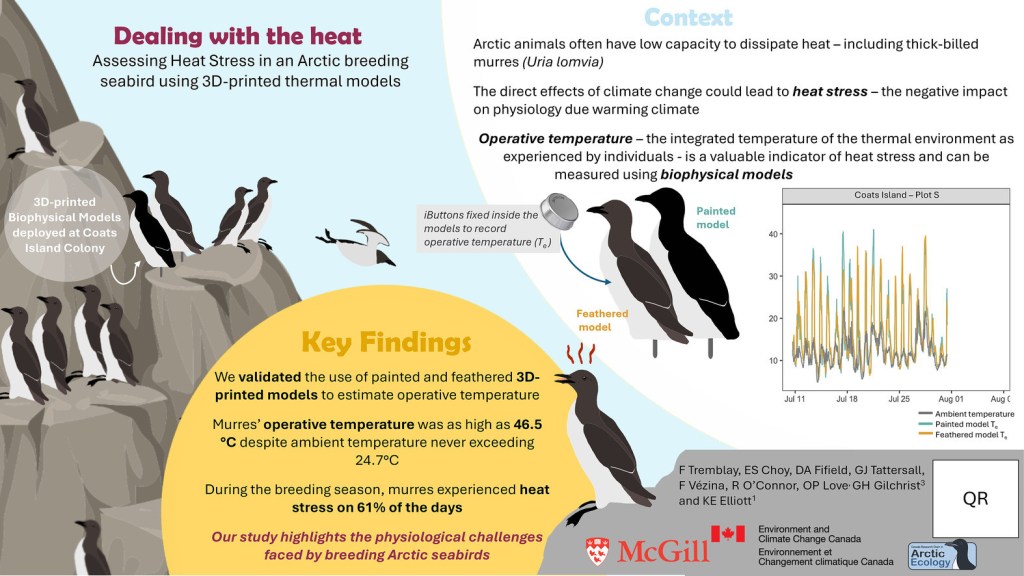
As the Arctic warms at an alarming pace, we’re learning that even cold-adapted species like the thick-billed murre aren’t immune to rising temperatures. This latest study, led by Fred Tremblay from Dr. Kyle Elliot’s lab at McGill adds to the growing understanding that cliff-nesting seabirds are experiencing heat stress far despite ambient air temperatures rarely exceeding 25°C. Using custom 3D-printed murre models painted to mimic the birds’ plumage, we measured “operative temperatures” (the actual heat experienced by an animal) on Coats Island, Nunavut. These operative temperatures soared as high as 46.5°C due to solar radiation and other environmental factors. In fact, murres faced heat stress conditions on 61% of summer breeding days, which can lead to significant water loss and physiological strain.
This work highlights the impact of climate change on Arctic wildlife and illustrates the value of biophysical modelling and how important it is to consider more than air temperature measurements in macroecology/macrophysiology (see https://doi.org/10.1111/1365-2656.12818 and https://doi.org/10.1002/ece3.5721).
These models, in combination with infrared thermal imaging, offer a non-invasive and cost-effective way to measure real-world thermal conditions, paving the way for better predictions of species vulnerability. With males incubating eggs during the hottest parts of the day, this heat stress isn’t just theoretical. It could shift breeding success, survival rates, and long-term population dynamics. These type of studies demonstrate the importance of microclimates in assessing the threats facing Arctic fauna and animals around the world.

For access to the study please follow the link in the citation below.
Citation
Tremblay F, Choy ES, Fifield DA, Tattersall GJ, Vézina F, O’Connor R, Love OP, Gilchrist GH, Elliott KH. 2025. Dealing with the heat: Assessing heat stress in an Arctic seabird using 3D-printed thermal models. Comp Biochem Physiol A Mol Integr Physiol. 306: 111880. https://doi.org/10.1016/j.cbpa.2025.111880
For amphibians, water is everything. Their thin skin makes them especially vulnerable to drying out, so staying hydrated is not just about comfort—it is about survival. But how do amphibians manage their hydration state in the face of different temperatures and fluctuating humidity?
Our recent study on spotted salamanders (Ambystoma maculatum) provides some new insights into this question. We exposed salamanders to two temperatures—17°C and 22°C—within a humidity gradient (Fig 1) to understand how salamanders behaved when given the choice to move toward more or less humid conditions under contrasting thermal conditions.

We found that salamanders consistently selected localities in the gradient that maintained a constant vapour pressure deficit (VPD), which is the key variable driving evaporative water loss (Figure 2). VPD reflects a more physiologically relevant metric for the “drying power” of air. Since they behaviourally regulate a constant VPD regardless of temperature, this provides support for a humidistat (i.e., that they regulate their water loss).

Virtually, what this means is that salamanders prefer higher relative humidity (RH) at 22°C than at 17°C to offset the increased drying power of the air at warmer temperatures. This suggests that salamanders are not just responding to RH or temperature independently. Instead, they are tuning into the combined effects that actually influence water loss.
Additionally, salamanders that selected higher VPDs (i.e., dryer conditions) lost more water, and body size also mattered, as larger individuals lost more water than smaller ones even after accounting for temperature. This highlights a trade-off between body size, humidity preference, and the risk of dehydration.
Temperature also played an important role in rehydration. Salamanders rehydrated faster at 22°C than at 17°C, suggesting that warmer conditions may boost water uptake—perhaps because of increased skin permeability at warmer temperatures, or from active processes that promote water uptake.
One of the most intriguing findings was the idea that salamanders might be able to sense how much water they are losing. We propose that local evaporative cooling of the skin—especially on the parts exposed to air—could serve as a sensory cue. If the dorsal skin is cooler than the ventral skin (which stays in contact with the moist substrate), that temperature difference might help the salamanders detect and respond to evaporative demand.
Overall, our study shows that rather than being passive victims of their environment, salamanders actively choose conditions that help them stay hydrated. Their behaviour is not random—it is a targeted response to complex environmental pressures.
One take home from this is that we can’t only measure relative humidity as an environmental predictor for microhabitat selection in salamanders and other ectotherms, but we need to incorporate the biophysical aspects of water loss. Hopefully this isn’t too scary!

For more information, please access the study here: https://doi.org/10.1242/jeb.250297 and the Inside JEB write-up here: https://doi.org/10.1242/jeb.250813
Citation
Giacometti, D and Tattersall, GJ. 2025. Behavioural evidence of a humidistat: a temperature-compensating mechanism of hydroregulation in spotted salamanders. Journal of Experimental Biology, 250297 https://doi.org/10.1242/jeb.250297
Blog Author: Danilo Giacometti
Harry Kumbhani was representing the lab at the Canadian Society of Zoologists conference last week in Waterloo with his stunning poster below. And he received a little message, possibly from a journal editor encouraging he submit the manuscript, perhaps?!
Well done Harry and thank you for all your hard work on that project. Hopefully there will be good news on this soon as we finalise the manuscript.


Congratulations to Harry Kumbhani for being awarded an Ontario Graduate Scholarship for his MSc research in my lab. With coursework out of the way, conferences and summer field work beckon, so the timing could not be better!
Ectotherms from highly seasonal habitats often exhibit remarkable physiological plasticity, which allows them to balanceand adjust energy and water budgets in the face of fluctuating climatic conditions. Yet, fossorial (i.e., underground-dwelling) ectotherms are thought to experience attenuated climatic variability underground, raising the question: do fossorial ectotherms also display seasonal adjustments in key physiological functions?
In our recent publication, we investigated how seasonal acclimation (spring vs. autumn) affected energy expenditure and water loss in the spotted salamander. By measuring standard metabolic rates (SMR) and rates of evaporative water loss (EWL), we aimed to disentangle acute (i.e., exposure to test temperatures) from prolonged (i.e., seasonal acclimation) effects.
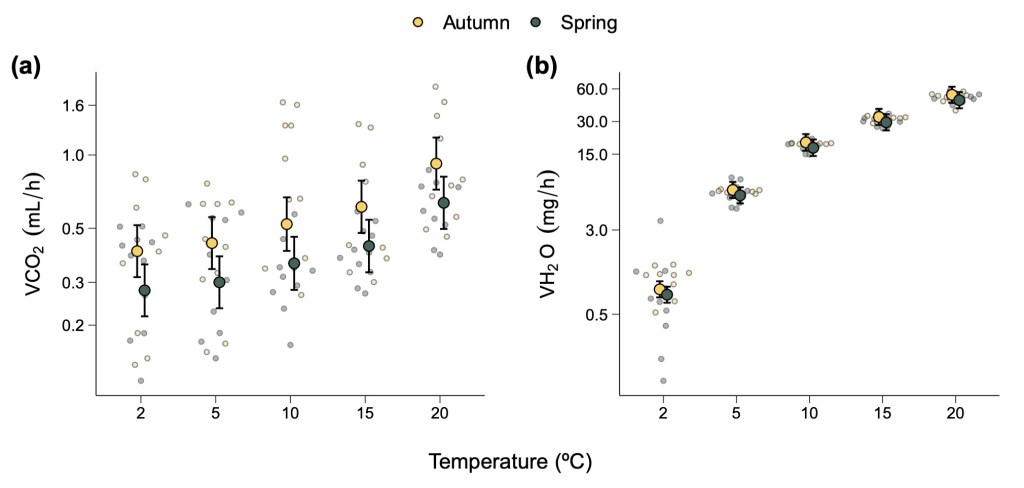
We found that increases in temperature led to increases in both SMR and EWL, demonstrating that fossorial salamanders also experience acute physiological costs when warmed. Salamanders had lower SMR in the spring, which may be beneficial in the context of overwintering emergence and breeding. In contrast, sustaining higher SMR in the autumn may allow salamanders to forage aboveground to replenish energy stores in preparation for the winter. EWL was stable between seasons, suggesting that salamanders may be more reliant on behavioural instead of physiological adjustments to manage water loss throughout the year. Together, our findings challenge the assumption that fossorial ectotherms are largely insulated from environmental fluctuations by virtue of living underground.
For more detailed information, you can access the full study here: https://doi.org/10.1007/s00442-025-05711-6
Citation
Giacometti, D, and Tattersall, GJ. 2025. Seasonal plasticity in the thermal sensitivity of metabolism but not water loss in a fossorial ectotherm. Oecologia. 207: 67. https://doi.org/10.1007/s00442-025-05711-6
A busy week with Honours student defences from the lab (and throughout the Department of Biological Sciences).
From our lab:
Margaret Kitney defended a brilliant thesis project on how and whether sex differences alters thermoregulatory behaviours in guppies (The effect of sex on the thermoregulatory behaviour of the Trinidadian guppy (Poecilia reticulata), having spent months watching fish swimming in shuttle boxes and months pouring over tracking algorithm detection processes. Truly a great amount of work and thought went into the thesis writing and explanations.
Natalie Bakker defended an awesome thesis project on bearded dragon cognition (Quantity Discrimination and Detour Task Performance of Bearded Dragons (Pogona vitticeps)), expanding our knowledge of how reptiles think and assess food resources. Months of challenges associated with our “lazy lizards”, but the project came together brilliantly in the end.


Congratulations to both!
For decades, the concept of a thermoregulatory “set-point” has been a cornerstone of physiological research, yet its definition and application remain surprisingly inconsistent across disciplines. Our recent study, spear-headed by the inimitable Dr. Duncan Mitchell, soon to be published in Biological Reviews, revisits and clarifies this fundamental concept by bridging perspectives from control theory and thermal biology. We explore how the set-point framework has been misinterpreted, and we argue for a more precise definition rooted in negative feedback principles. By revisiting foundational work and integrating recent empirical data, we demonstrate that set-points should not be conflated with operating body temperatures. Instead, they represent the thresholds at which thermo-effectors—such as sweating, shivering, or behavioural thermoregulation—are activated.
By incorporating an historical perspective, and combining control theory research with research into behavioural thermoregulation in lizards, our work highlights that, while lizards select body temperatures within a narrow range under stable conditions, their ability to do so is governed by multiple overlapping control mechanisms rather than a singular, static reference point.
This nuanced understanding has broad implications for comparative physiology and ecological research, especially in the face of climate change. The mischaracterization of set-points has led to confusion in both homeothermic and ectothermic species, potentially skewing interpretations of thermal adaptation and stress responses. By refining the definition of set-points within a rigorous control-theory framework, our study provides a clearer foundation for future research on thermal biology. We emphasize the importance of distinguishing between physiological thresholds and behavioral outcomes, urging researchers to adopt a systems-based approach to thermoregulation. Ultimately, our work seeks to reframe the discussion, ensuring that the next generation of studies can build on a more precise and unified conceptual framework.
This review is part of a series of “Misconceptions in thermal biology” papers, mainly from the Brain Function Research Group in South Africa, but the list of co-authors includes experts in thermal physiology and ecophysiology. Stay tuned for more papers in the future, and I encourage anyone new to thermoregulation and thermal biology research to read some of these.
Citation
Mitchell, D, Fuller, A, Snelling, EP, Tattersall, GJ, Hetem, RS, and Maloney, SK. 2025. Revisiting concepts of thermal physiology: understanding negative feedback and set-point in mammals, birds, and lizards. Biological Reviews. https://doi.org/10.1111/brv.70002
For other misconceptions in thermoregulation papers see:
 Tattersall Lab (TEMP)