Major milestone: Most # of backers!

We just heard from experiment.com that our crowd-sourced hummingbirds proposal has won the “most number of backers” category (just over 100 at this point in writing) which means our project received an additional $500 from the Experiment.com people.

Stay tuned for more info in 14 days, when the fund raising period is over and we can start the hard work sourcing equipment, supplies and arranging the field work.

Thank you to all of our backers!

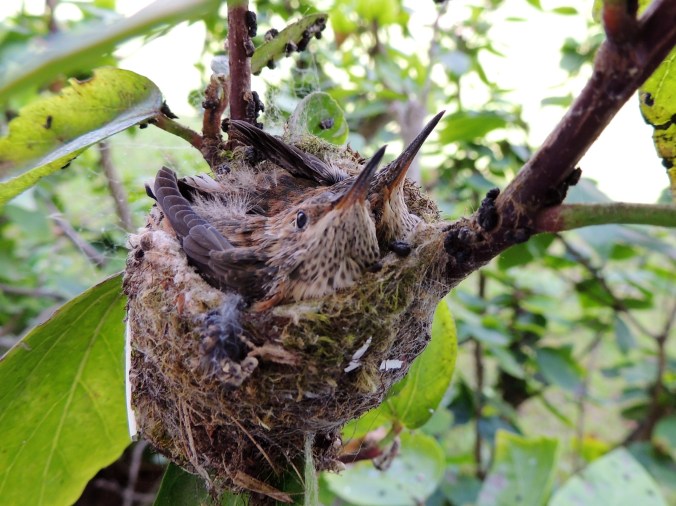
vyyh97xqeu4wvgcgdnsg_allens20nestlings

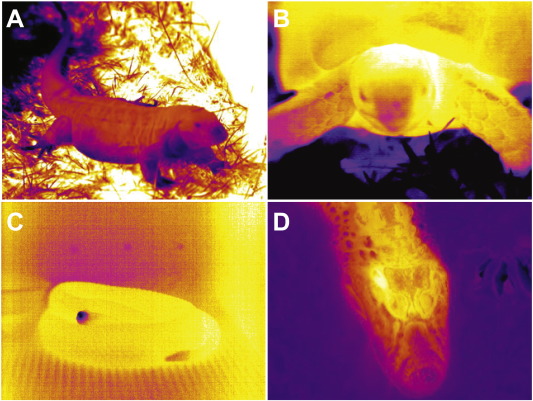
Review paper on Infrared Thermography in Ecophysiology

My Infrared Thermography Review paper is finally out!  (Elsevier does have a slow publication process…it was accepted in March, but thankfully published in the same calendar year: 2016).

For a limited time, this paper is freely available at the following link:

http://www.sciencedirect.com/science/article/pii/S1095643316300435

1-s2-0-s1095643316300435-gr9


The review is part of a special issue on “Ecophysiology methods: refining the old, validating the new and developing for the future” edited by Dr. Jordi Altimiras and Dr. Gary Anderson found here:

http://www.sciencedirect.com/science/journal/10956433/202/supp/C

I think this special issue will be a useful resource for physiologists taking their research into the field as well as ecologists who should learn some physiology before they start using these approaches.

Half-way there…

So, as of today (Nov 15th), our crowd-sourced research fund raising campaign reached the 50% mark!  This is great news, and we still have 17 days left.

I feel like someone selling cookies door to door, but here is the link for anyone interested in our kind of research and showing their interest in the form of currency.

https://experiment.com/projects/a-mother-s-work-is-never-done-using-thermal-imaging-to-detect-torpor-in-nesting-hummingbirds


10959690_1418895448408128_6118962362051315217_n

Physiology is where Anatomy hits the road

I just received the American Association of Anatomists (AAA) newsletter where there is a nice summary and write-up about the symposium that Dr. Ruger Porter and myself hosted earlier this year at the International Congress of Vertebrate Morphology.

What a great bunch of researchers.  Our discussions before and after the symposium were some of the most interesting I have had.  It is definitely worth crossing disciplinary boundaries and working with new people.

The AAA kindly provided financial support for our symposium, which was crucial to its success.

Here is the link and the summary pasted below.

http://amasan.informz.net/admin31/content/template.asp?sid=45327&ptid=1383&brandid=3960&uid=825288979&mi=5698344&ps=45327


Research Meeting Outreach Grant at ICVM: Bringing Together Anatomists and Physiologists From Around the World
By Wm. Ruger Porter, Lecturer of Human Anatomy, Ohio University Heritage College of Osteopathic Medicine;
Glenn Tattersall, Professor of Physiology, Brock University
From June 29 – July 3 2016, the International Congress of Vertebrate Morphologists hosted a symposium designed to bring together anatomists and physiologists from around the world to present their research on the functional relationship between anatomy and physiology. The American Association of Anatomists Research Outreach Grant supported travel for seven researchers from Japan, South Africa, Canada, and the United States. Each presentation had a physiological question at its core, and explored that question from either an anatomical or physiological perspective. Wm Ruger Porter’s presentation provided evidence for the anatomical and physiological role of blood vessels in the thermoregulatory strategies of dinosaurs and their modern relatives. Glenn Tattersall showed that bird beak morphology influences its ability to shed heat and is subject to selection by environmental temperatures. Colleen Farmer presented her lab’s research on the relationship between red blood cell size, maximum oxygen consumption and metabolic status, and provided provocative evidence in modern taxa to assist in predicting extinct taxa metabolic status. Shoji Hayashi provided details on the bone histology of island deer that allowed them to calculate the metabolic status of an extinct deer species. Maartin Strauss provided several new insights into the physiological role of the artiodactyl carotid rete, including which physiological parameters influence water conservation. Jason Bourke’s presentation provided evidence for the anatomy of the nasal cavity in five dinosaur species and the role of nasal cavity morphology in thermoregulation and water conservation. Finally, Haley O’Brien presented her research on not only the anatomy and physiology of the artiodactyl carotid rete, but also its role in shaping the evolutionary success of artiodactyls.

Most of the participants in this symposium were young scientists that earned their degrees within the last five years. The Research Outreach Grant alleviated travel costs, providing critical support for their participation in this ICVM symposium, and ensured their opportunity to present their cutting-edge research to an international audience and interact with world-class researchers to foster new interdisciplinary collaborations

Using thermal imaging to detect torpor in hummingbirds

Please consider supporting an initiative from a student (Erich Eberts) from Loyola Marymount University to use thermal imaging in order to monitor and detect torpor use in nesting hummingbirds.  This is a first for me, to be assisting in a crowd-sourcing approach to research, and I think it lends itself extremely well to student initiated research, but all the credit goes to the students Erich Eberts and Anusha Shankar for all their hard work at putting together this proposal.

The link to the fund raising campaign is here, on the Experiment.com website.  The title of the proposal:

Using Thermal Imaging to Detect Torpor in Nesting Hummingbirds

Although I might not make it into the field with Erich, I will provide analytical support and assistance with the thermal image analysis.  I have long been watching the hummingbirds that fly past my office window (see videos below) and have even seen them rearing their young outside my office window (in Canada), but Erich is interested in testing a very interesting question about whether and how much females engage in nightly torpor when they are actively incubating eggs and rearing young.  If funded, he will have his own, portable thermal cameras to use in the field and hopefully capture not only stunning science videos, but also useful data on the extent to which torpor is used during incubation.

I wish I could loan him my thermal camera, but mine is heavily used and also off being serviced and calibrated.  The bill for that is $2500, so I think the budget proposed for this project is very modest.

10959690_1418895448408128_6118962362051315217_n


Help with selecting papers for a course

I am looking for suggestions for interesting research papers for a seminar course on Biology of Sensory Systems.  You may suggest your own papers, as I would like to assemble a list of possible research papers to a class of 20 senior biology students who have a background in physiology, neurobiology, or cell biology.

The course could cover cellular mechanisms or behavioural evidence for how animals sense the environment.  Possible topics would be olfaction, thermosensation, photosensitivity, mechanosensation, nociception, UV detection, magnetoreception….to name a few.  The course will not cover aspects of central processing or perception of sensory information within the CNS, as I would like the emphasis to be on the peripheral aspects of sensation.

Non-mammalian and non-human example are especially welcome, since this is for biology majors.

I have posted this question on Researchgate as well.

16632980-abstract-word-cloud-for-sensory-system-with-related-tags-and-terms-stock-photo

Off to my first paleontology meeting, in Utah!

My final conference trip of the year, this time to a paleontology meeting!  I leave on wednesday (arriving a day late, sadly).

http://vertpaleo.org/annual-meeting/annual-meeting-home.aspx

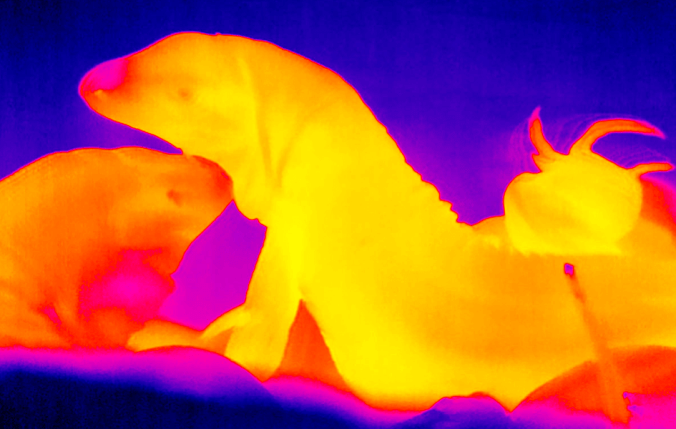
I will be speaking about our paper published earlier this year on reproductive endothermy in tegu lizards, in a symposium organised by Colleen Farmer, Jennifer Botha-Brink, and Adam Huttenlocker, entitled “Recent Advances in Understanding the Origins and Evolution of Tetrapod Endothermy”

I’m looking forward to interacting with a group of paleontologists and hope they don’t mind hearing about some research on an extant animal!

For those interested, the title of my talk:

“Facultative thermogenesis in tegu lizards provides metabolic support for the parental care model of endothermy”
 

Teguthermal

Here is the symposium information:

Recent Advances in Understanding the Origins and Evolution of Tetrapod Endothermy
Co-convenors: Colleen G. Farmer, Jennifer Botha-Brink, and Adam K. Huttenlocker

Endothermy, the ability to use metabolically generated heat to regulate internal body temperature above ambient, represents a key innovation driving mammalian and avian evolution, allowing them to shorten the time between conception and sexual maturity, and to exploit new habitats and resources not accessible to ectotherms. Because of this, understanding the evolutionary origins of endothermy has become a central question in vertebrate paleobiology and evolutionary physiology. Many physiologic adaptations that either promote or were a consequence of endothermy are shared between mammals and birds, but major questions surround their origins and early evolution: What fossilizable markers of endothermy are accessible to paleontologists? What were the selective agents that have driven this novel thermoregulatory physiology? What were the paleobiological and ecological contexts for its origins? When and how many times did endothermy evolve? In recent years, new information from non-mammalian synapsids and archosaurs has begun to reshape our views of their paleophysiology, including their capacities for fast growth, cardiopulmonary physiology, and insulation and thermoregulation. The growing body of new data makes this a timely topic that will throw into sharp relief what is and isn’t known, and will promote cross-pollination of research in light of the vertebrate fossil record.

This symposium will feature interdisciplinary research that exemplifies the diversity of new studies that shed light on the origins and early evolution of tetrapod endothermy. Symposium contributors will consist of an international list of scientists who employ a variety of tools to pinpoint the functional correlates of endothermy and their evolutionary origins in synapsids, archosaurs, and other tetrapod groups. Presentations will therefore span taxonomic boundaries, and will appeal to attendees actively researching paleophysiology in extinct tetrapods and to those interested in all aspects of vertebrate paleobiology. Major topics will include a variety of techniques and study systems, including (1) bone histological applications, (2) functional morphology, (3) metabolic scaling, (4) micro-computed tomographic techniques, and (5) clumped isotope paleothermometry. In light of the rapid changes in the field, this symposium will generate broad interest across multiple disciplines, as well as in the lay community, and will guide future research.
 

Evolution of the avian bill as a thermoregulatory organ

After a year in the making (4 months of that waiting for the journal review process), our review paper is finally published!  The link can be found here:

http://onlinelibrary.wiley.com/doi/10.1111/brv.12299/full

For those without access, please feel free to contact me for an e-offprint.

This review represents a collaboration with my good colleague, Dr. Matthew Symonds (Deakin University) and a Brock student, Bassel Arnaout, who contributed to the writing and research, and summarises the evidence for how temperature has shaped bird bill size.


Seminar on Hummingbird Physiology

I am pleased to be able to host Dr. Kenneth Welch today, who will be giving a seminar in the Department of Biological Sciences, Brock University on:

“Glucose, fructose and the energetics of hovering flight”

Ken is currently on sabbatical, but was gracious enough to add us to his travel schedule while back at his home institution (U of Toronto, Scarborough).

Location: MacKenzie Chown H313

Date/Time: Oct 7, 2016, 14:15

His research into hummingbird physiology sheds light on how locomotion is influenced by the environment and how one of the most intensely powered muscles receive the necessary fuels to power their activity.

10959690_1418895448408128_6118962362051315217_n

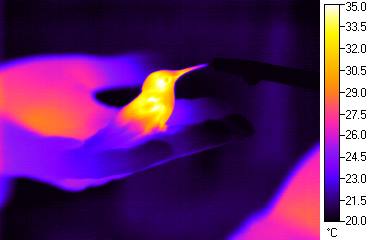
Thermal image of a ruby-throated hummingbird.


New Paper from the lab

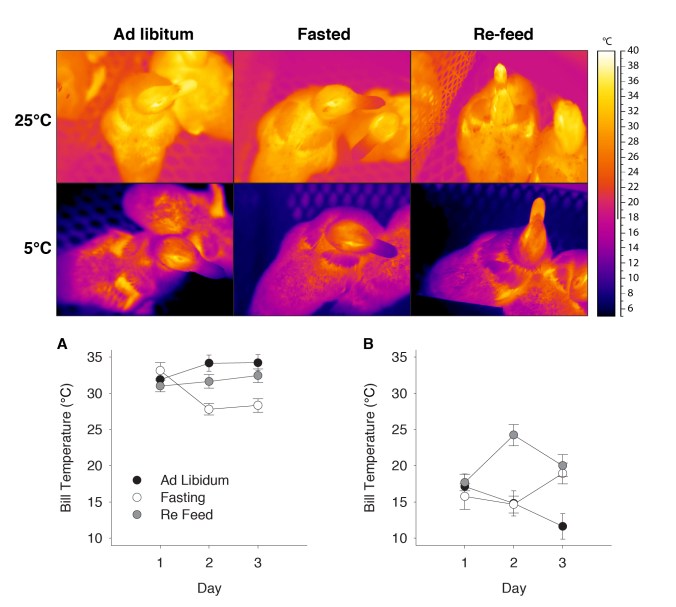
A paper resulting from my 3 month sabbatical stint at the Univeristé de Lyon has just been published in the Proceedings of the Royal Society B.  Using a small recording device that remains inside the crop, we were able to examine core temperature relationships over the course of growth, feeding, and fasting.  In the process, we discovered that fasting leads to greater heat conservation (revealed via thermal imaging) as well as changes to short term core temperature changes.  Ducklings show lower core temperature variation in the short term when fasting than when fed.

Here is the citation:

Tattersall GJ, Roussel D, Voituron Y, Teulier L (2016) Novel energy-saving strategies to multiple stressors in birds: the ultradian regulation of body temperature. Proceedings of the Royal Society B 283(1839): 20161551. http://dx.doi.org/10.1098/rspb.2016.1551

Electronic supplementary file is here.

Here are the data, uploaded to data dryad data repository:

Tattersall GJ, Roussel D, Voituron Y, Teulier L (2016) Data from: Novel energy-saving strategies to multiple stressors in birds: the ultradian regulation of body temperature. Dryad Digital Repository. http://dx.doi.org/10.5061/dryad.gt5c0

And a sample figure:

Figure 3 Thermal Images.jpg