Shrinking Shorebirds & How Climate is Reshaping Them

Shorebirds across Australia are experiencing notable changes in size and shape, offering a vivid example of climate change’s impact on wildlife. In a recent publication in Ecology Letters (McQueen et al), using comprehensive 46-year study involving over 200,000 observations across 25 species we show widespread declines in body size (“shrinking”) and concurrent increases in bill length (“shape-shifting”). These shifts appear to align with thermal adaptation, where smaller bodies and elongated bills would help dissipate heat more effectively in warmer environments. However, we also found that smaller species exhibited the most pronounced changes, while long-distance migratory species showed weaker trends, possibly due to physical constraints needed for efficient flight over vast distances.

Interestingly, while bill lengths have generally increased over time, they shortened following exposure to recent hot summers, hinting at complex evolutionary trade-offs between short-term vs. long-term climatic fluctuations.  We suggest these changes may reflect not only adaptations for thermoregulation but also responses to nutritional stress or other environmental pressures. These findings emphasize the dual role of climate change as both a selective force and a stressor. As global temperatures continue to rise, understanding these morphological changes is crucial for predicting their effects on species survival and the ecosystems they inhabit.

Field sites and climate information for northern and southern Australian shorebird populations. A and B show locations where shorebirds have been sampled by members of the VWSG and AWSG (black circles) and nearby Australian Bureau of Meteorology weather stations with summer temperature data from 1970-2021 (blue triangles); colour scale shows average summer daily maximum temperatures (December-February). 

To read more about the study, it in open access below. 

Citation

A. McQueen, M. Klaassen, G. J. Tattersall, S. Ryding, Victorian Wader Study Group, Australasian Wader Studies Group, R. Atkinson, R. Jessop, C. J. Hassell, M. Christie, A. Fröhlich, M. R. E. Symonds. 2024. Shorebirds are shrinking and shape-shifting: declining dody size and lengthening bills in the past half-century. Ecology Letters. 27:e14513. https://doi.org/10.1111/ele.14513

When Salamanders Surface: Understanding the Secrets Behind Spotted Salamander Overwintering Emergence

Amphibians have long fascinated researchers due to their unique life cycles and environmental sensitivities, but many aspects about the biology of fossorial (i.e., burrowing) species remain shrouded in mystery. Fossorial amphibians like the Spotted Salamander (Ambystoma maculatum) spend most of their lives underground, emerging to the surface only briefly to breed or forage. In our latest paper, we address some of the intrinsic and extrinsic factors that may trigger emergence from overwintering by evaluating the interplay between temperature, gravity, and innate migratory cues over salamander behaviour.

Our study focussed on the role of soil temperature inversion—a seasonal shift where surface soils warm faster than deeper layers—in signalling salamanders to leave their winter refuges and begin their overland journey to breeding ponds. Using a vertical thermal gradient in the lab, we examined how salamanders responded to temperature cues at different depths and whether their activity levels changed with temperature shifts that mimicked soil temperature inversion. Our findings suggested that salamanders are not only tolerant of a wide thermal range but are also displaying a circannual phenomenon known as “migration restlessness”. Migration restlessness is characterised by a surge in movement often seen in animals preparing to migrate. Coupled with negative geotaxis, a tendency to move upward against gravity, this restless behaviour may explain why salamanders begin their spring migration at just the right moment, maximising their chances of reproductive success while avoiding the dangers of emerging too early and potentially freezing.

Representation of soil temperature inversion in the forest surrounding Bat Lake, Algonquin Provincial Park, ON, Canada, from where the spotted salamanders were collected.

A. Schematic of the vertical thermal gradient used to assess the effects of thermal inversion and gravity on salamander behaviour. Thermal image of the active (B) and overwintering (C) thermal gradients used in the study. The thermal gradient was always kept at a 45º angle relative to the horizontal axis, imitating underground burrows. 

Sped-up time-lapse of a male Ambystoma maculatum tested within the active thermal gradient. Frames were taken every 30 s, for a total of 18 h of experiment (20 frames/sec).

For a link to an interview with the first author ECR, Danilo Giacometti, please see the following link.

For a link to the paper, please see the citation below.

Citation

Giacometti D., Moldowan P. D., Tattersall G. J.; Ups and downs of fossorial life: migration restlessness and geotaxis may explain overwintering emergence in the Spotted Salamander. J Exp Biol 2024; jeb.249319. doi: https://doi.org/10.1242/jeb.249319

Blog Author: Danilo Giacometti

Shape-Shifting in the Face of Climate Change: The Long and the Short of How Australian Birds Are Adapting

As global temperatures rise, animals are facing mounting pressure to adapt, and Australian birds are no exception. Our recent research (from Sara Ryding’s PhD research) has examined over 5,000 museum specimens, representing 78 bird species across Australia, revealing clear changes in their body and appendage sizes. These changes are aligned with two well-known ecological principles: Bergmann’s rule, which predicts smaller body sizes in warmer climates in endotherms, and Allen’s rule, which argues that animals (namely endotherms) will develop larger appendages to regulate body heat. Consistent with these theories, our study found that birds are experiencing a long-term decrease in body size, particularly in absolute wing length, while their appendages, such as bills and tarsi (leg bones), are getting larger relative to their bodies. This phenomenon, often referred to as “shape-shifting,” is a widespread response to the increasing temperatures driven by climate change.

Interestingly, our research also highlights a more complex picture when it comes to short-term responses. While long-term trends show a clear increase in appendage size to aid thermoregulation, birds displayed smaller appendages in the years following hotter temperatures. This suggests that while birds are gradually adapting to rising temperatures over time, short-term weather events may create different selection pressures that affect growth and development. Factors like food availability and reproductive challenges could contribute to these opposing trends. This study underscores the intricate balance between long-term evolutionary changes and the immediate pressures exerted by fluctuating environmental conditions, offering critical insights into how birds—and potentially other animals—might continue to respond to our rapidly changing world.

For a link to the study, please see the citation below.

Citation

Ryding, McQueen, A, Klaassen, M, Tattersall, GJ, and Symonds, MRE. 2024. Long- and short-term responses to climate change in body and appendage size of diverse Australian birds. Global Change Biology, 30:e17517. https://doi.org/10.1111/gcb.17517

Twists of fate and the hidden story of salamander abnormalities

A new paper has been accepted in the Canadian Journal of Zoology, resulting from Gloria Gao’s (Njal Rollinson’s lab at University of Toronto) hard work and based (in part) on the long-term study of the spotted salamanders at Bat Lake, Algonquin Park along with other field sites in Algonquin Park.

This study investigates the prevalence and fitness consequences of morphological abnormalities in Spotted Salamanders (Ambystoma maculatum) within an uncontaminated ecosystem in Algonquin Provincial Park, Canada. Over a 12-year period, the study found that abnormality rates ranged from 4.3% to 5.8% annually, aligning with baseline frequencies observed in other minimally impacted amphibian populations. Interestingly, despite expectations that abnormalities might reduce fitness, salamanders with abnormalities in this study displayed slightly higher body condition and significantly earlier arrival times at breeding sites—traits typically associated with high fitness. These results suggest a potential survivorship bias, where only individuals with favourable genetic or environmental factors survive to be observed, masking the true impact of abnormalities.

The study also highlights the importance of understanding abnormality rates in uncontaminated environments, as these can provide valuable baselines for comparison with more impacted habitats. It appears that Caudata (salamanders and newts) generally have a higher prevalence of abnormalities compared to Anura (frogs and toads), although the reasons for this remain speculative. The findings from this study underscore the complex relationship between abnormalities and fitness and emphasize the need for further research to explore how environmental factors influence these dynamics in amphibian populations.

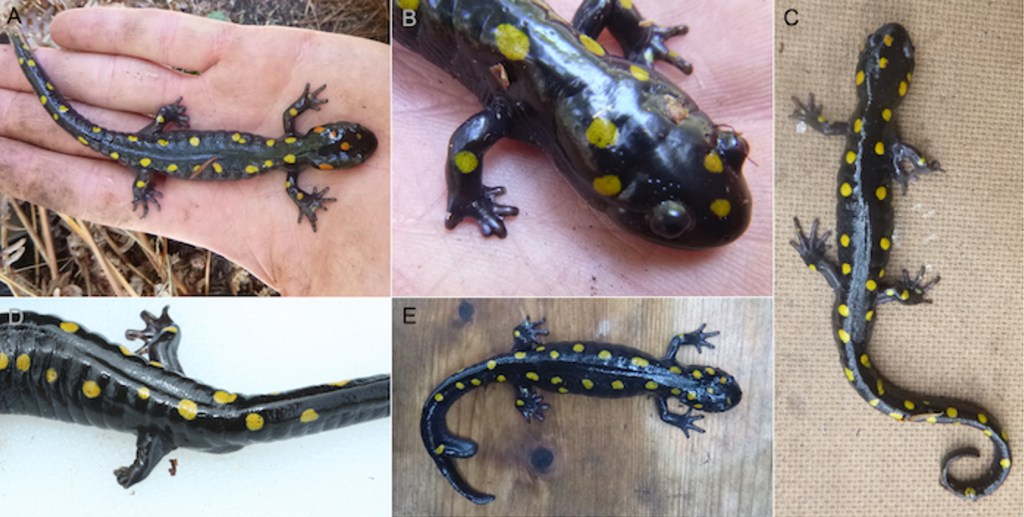
Examples of abnormalities observed among Spotted Salamanders at Bat Lake, Algonquin Provincial Park: A. polydactyly (additional phalanges) resulting from partial duplication of the hand on the right forelimb; B. partial syndactyly (fused digits) and abnormal arrangement of the right forelimb phalanges; C. polymelia (limb duplication) of the right forelimb; D. micromelia (proportionately small or short limb) of the left hindlimb demonstrating early stage regeneration following probable amputation; E. tail bifurcation.

Citation

Gao, GHY, Moldowan, PD, LeGros, DL, Sahar, M, Tattersall, GJ, and Rollinson, N. 2024. Frequency of adult amphibian abnormalities and consequences for traits related to fitness in an uncontaminated environment. Canadian Journal of Zoology, doi.org/10.1139/cjz-2024-0063.

Proofs are not yet available, but will update when they are.

Salamanders show inherent seasonal differences in thermal preference

Very pleased to have my PhD student, Danilo Giacometti’s paper accepted recently in Royal Open Science. This represents the culmination of over a year’s work carefully measuring temperature selection. He has a much better blog post here on the subject by Danilo Giacometti, but I’ll post the abstract and citation below.

Abstract

Temperature seasonality plays a pivotal role in shaping the thermal biology of ectotherms. However, we still have a limited understanding of how amphibians maintain thermal balance in the face of varying temperatures, especially in fossorial species. Due to thermal buffering underground, theory predicts relaxed selection pressure over thermoregulation in fossorial ectotherms. As a result, fossorial ectotherms typically show low thermoregulatory precision and low evidence of thermotactic behaviours in laboratory thermal gradients. Here, we evaluated how temperature selection (Tsel) and associated behaviours differed between seasons in the Spotted Salamander (Ambystoma maculatum). By comparing thermoregulatory parameters between the activity and overwintering seasons, we show that Amaculatum engages in active behavioural thermoregulation despite being fossorial. In both seasons, Tsel was consistently offset higher than prevailing thermal conditions. Thermoregulation differed between seasons (see table below), with salamanders having higher Tsel and showing greater evidence of thermophilic behaviours in the active compared to the overwintering season. Our study highlights that the combination of behavioural and thermal biology measurements is a necessary step to better understand the mechanisms that underlie body temperature control in amphibians. Ultimately, we provide a broader understanding of thermoregulation in the context of behavioural responses to seasonality in fossorial ectotherms.

Citation

Giacometti, D and Tattersall, GJ. 2024. Seasonal variation of behavioural thermoregulation in a fossorial salamander (Ambystoma maculatum). Royal Open Science, https://doi.org/10.1098/rsos.240537

Just how big is that bill?

Dr. Sara Ryding’s next thesis chapter just came out in the Journal of Avian Biology. Sara (co-supervised) just finished her PhD with Matt Symonds, Deakin University. Congratulations Sara!

Here is a summary of the study:

Unidimensional measurements for estimating bill size, like length and width, are commonly used in ecology and evolution, but can be criticised due to issues with repeatability and accuracy. Furthermore, formula-based estimates of bill surface area tend to assume uniform bill shapes across species, which is rarely the case. 3D surface scanning can potentially help overcome some such issues by collecting detailed external morphology and direct measurements of surface area, rather than composite estimates of size. Here, we evaluate the use of 3D surface scanners on avian museum specimens to test the repeatability of 3D-based measurements and compare these to traditional formula-based methods of estimating bill size from unidimensional measurements. Using 28 Australian bird species, we investigate inter-observer repeatability of surface area measurements from 3D surface scans. We then compare 3D-based size estimates to formula-based size estimates to infer the accuracy and precision of formula-based measurements of bill surface area. We find that morphometric measurements from 3D surface scans are highly repeatable between observers, without the need for extensive training, demonstrating an advantage over unidimensional measuring methods, like callipers. When comparing 3D-based measurements to formula-based estimates of bill surface area, most formulae for estimating size consistently underestimate surface area, and with considerable variation between species. Where 3D scanning is not possible, we find that a commonly used cone formula for estimating bill size is most precise across diverse bill shapes, therefore supporting its use in interspecific contexts. However, we find that incorporating an additional unidimensional measure of bill curvature into formulae improves the accuracy of the calculated area. Our results reveal the high potential for 3D surface scanners in avian morphometric research, especially for studies necessitating large sample sizes collected by multiple observers, and gives suggestions for formula-based approaches to estimate bill size.

Citation

Sara RydingGlenn J. TattersallMarcel KlaassenDavid J. WilkinsonMatthew R. E. Symonds 2024. Measuring avian bill size: comparing and evaluating 3D surface scanning with traditional size estimates in Australian birds. Journal of Avian Biology, 2024 e03248. https://doi.org/10.1111/jav.03248

Animal Behaviour Society Presentation

Melanie Denommé (PhD student in the lab) is attending the Animal Behaviour Society meeting today, presenting on her PhD research, entitled “Enclosure style preferences are influenced by experience in bearded dragons (Pogona vitticeps)“.

She shows some intriguing results about how early life exposure to different housing conditions alters subsequent preference tests for how bearded dragons interact with enrichments!

Curious Case of Self-Inflicted Injury in Bearded Dragons

A study from the lab has just been published on a rare behaviour in our bearded dragons.  Missing toes are a reasonably common observation in group housed lizards, with the usual explanation being hungry cage-mates attacking one another, perhaps confusing toes with food or perhaps simply as possible food. However, we report on something quite different here. Over a span of two years, Melanie Denommé (PhD candidate) meticulously observed the behaviour of P. vitticeps housed in laboratory settings and noted that on rare occasions, the lizards would bite their own toes!  We saw this in both juvenile and adult individuals, albeit infrequently. Interestingly, the behaviour occurred in the presence of various environmental conditions, including loose substrates, hot surfaces, and during periods of ecdysis (shedding of skin).

The self-directed toe-biting behaviour involves the lizard assuming a distinctive posture, often resembling a C-shape, before striking at its toes with its tongue. This behaviour, which closely resembles regular eating behaviour, typically lasts for less than a minute. When we saw a call for papers on rare behaviours and proposals for hypotheses for these behaviours from the journal In&Sights, we decided to submit our observations there, and experience the new, open access form of peer review. 

While the function of this behaviour remains unclear, we proposed several hypotheses to elucidate its purpose.

One hypothesis suggests that self-directed toe-biting may serve a grooming or cleaning function, aiding in the removal of loose particulate matter caught between the toes or facilitating ecdysis. However, evidence supporting this hypothesis is inconclusive, as the behaviour was not consistently associated with shedding cycles, and no instances of using the mouth for shedding have been observed in related lizard species.

Another hypothesis posits that self-directed toe-biting may be a maladaptive behaviour resulting from captivity-induced stress or discomfort. This hypothesis is supported by observations of the behaviour occurring after extensive basking or gaping, potentially indicating overheating or discomfort in the lizards. However, the exact stimuli triggering the behaviour remain unclear, and further research is needed to explore its underlying causes.

A third hypothesis suggests that self-directed toe-biting may be a form of self-injurious behaviour linked to perceived stress or neurological factors. While this hypothesis offers insights into potential behavioural abnormalities, no clear correlations between self-directed toe-biting and other stress-related behaviours were observed in the study population.

Throughout the study, we meticulously documented occurrences of self-directed toe-biting using time-lapse cameras. Despite its infrequent occurrence, the behaviour was noted in multiple individuals, suggesting that it may be a natural variation within the species rather than an isolated anomaly.

This study on self-directed toe-biting in captive Pogona vitticeps offers valuable insights into the complexities of animal behaviour and adaptation. By exploring potential hypotheses and documenting observations meticulously, we hope to encourage future research aimed at unravelling the mystery behind this intriguing behaviour and its significance to the lives of these fascinating reptiles.

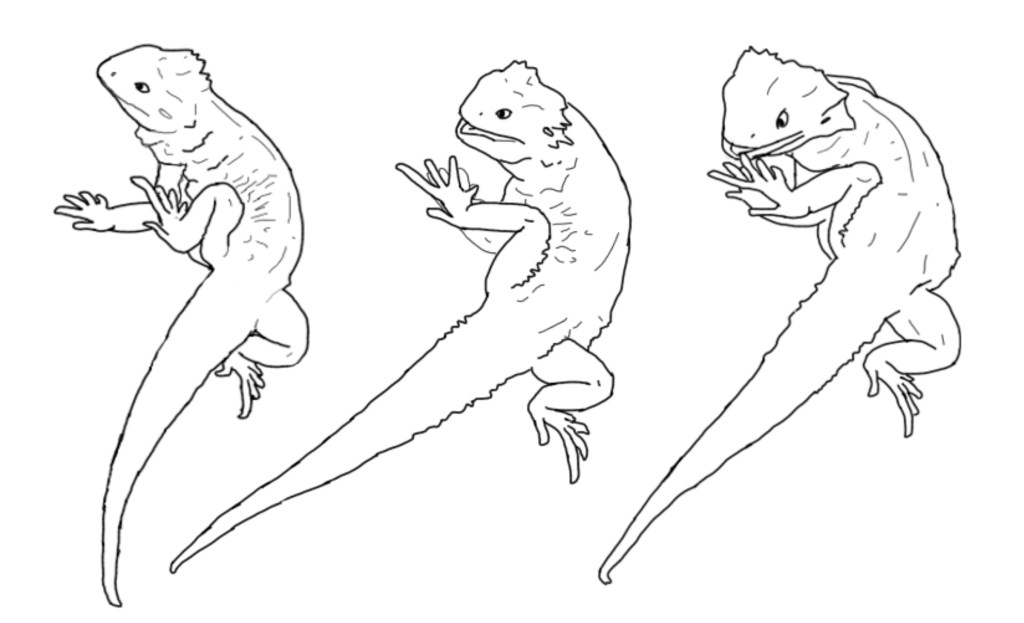
Illustration of the steps of self-directed toe-biting behaviour. The lizard begins by raising their leg close to their face, then may straighten the leg or curve the head towards the foot. The lizard may also bend their head down to meet their foot. Finally, leading with the tongue, the lizard strikes at their toes repeatedly. The behaviour ends when the foot returns to its original position

Citation

Denommé, M and Tattersall, GJ. 2024. Self-directed toe-biting in captive Pogona vitticeps. In&Vertebrates https://doi.org/10.52732/VOZL2285

Link to Paper

https://inandsight.science/journal/papers/65259e2f890bbf5b40a4ef45

Link to Video Demonstrating the Behaviour

https://doi.org/10.5683/SP3/JQ7UGP

 A time-lapse based video clip of Pogona vitticeps demonstrating toe-biting behaviour. Videos were generated from still images captures at 1 frame per second, with playback at 30 frames/second, so the behaviours are sped up ~30 times.

Bird limbs control heat loss better than bills

Our paper using field thermal imaging in Australian birds has just been published in Biology Letters. We demonstrate that bird limbs exert greater control over peripheral heat loss than bird bills. Here is a link to the study.

Abstract

Endotherms use their appendages—such as legs, tails, ears and bills—for thermoregulation by controlling blood flow to near-surface blood vessels, conserving heat when it is cold, and dissipating heat in hot conditions. Larger appendages allow greater heat dissipation, and appendage sizes vary latitudinally according to Allen’s rule. However, little is known about the relative importance of different appendages for thermoregulation. We investigate physiological control of heat loss via bird bills and legs using infrared thermography of wild birds. Our results demonstrate that birds are less able to regulate heat loss via their bills than their legs. In cold conditions, birds lower their leg surface temperature to below that of their plumage surface, retaining heat at their core. In warm conditions, birds increase their leg surface temperature to above that of their plumage surface, expelling heat. By contrast, bill surface temperature remains approximately 2°C warmer than the plumage surface, indicating consistent heat loss under almost all conditions. Poorer physiological control of heat loss via bird bills likely entails stronger selection for shorter bills in cold climates. This could explain why bird bills show stronger latitudinal size clines than bird legs, with implications for predicting shape-shifting responses to climate change.

Sample thermal images of study birds, showing the range of cool and warm limbs and bills. We captured images from 14 species of Australian birds at various environmental conditions to construct a probability of heat loss emanating from each appendage.
Image analysis involves dividing the thermal image into component parts and extracting temperatures from these regions of interest.
With thermal imaging, all body regions are strongly related to air temperature, so in any study employing thermography, accurate, real-time measurements of air temperature (and solar radiation) are required to make sense of the data.

In the paper, we incorporate biophysical modelling of the two, well vascularised appendages to estimate the actual heat flux from the appendage (incorporating solar radiation, wind speed, relative humidity measurements) and then simplify this down to a simple metric of whether the appendage was losing heat or not.

Citation

McQueen, A, Barnaby, R, Symonds, MRE, and Tattersall, GJ. 2023. Birds are better at regulating heat loss through their legs than their bills: implications for body shape evolution in response to climate. Biology Letters. 19: 20230373. https://doi.org/10.1098/rsbl.2023.0373

Acknowledgements

The data from this study were collected by A McQueen and R Barnaby. We thank Scott Rolph, Robin Sinclair, Robert Moore, Mike Weston and Chris Purnell for help with fieldwork, private landowners for access to properties and reviewers for their helpful feedback. We acknowledge the Wurundjeri, Bunurong, and Wadawurrung People as Traditional Owners of the land on which fieldwork was carried out.