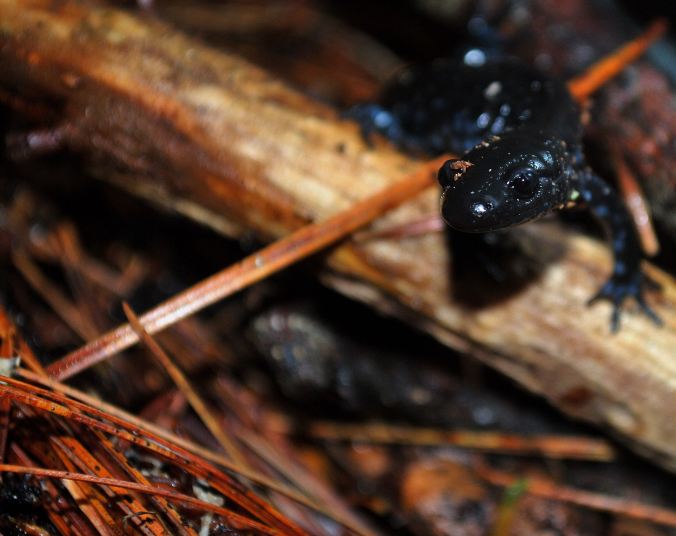
Danilo Giacometti was interviewed by NPR a couple of weeks ago about our blue-spotted salamander paper in CJZ, and the interview came out today (December 24, 2025). Check it out here:
A recent paper from the lab, led by PhD student Melanie Denommé, examines a foundational assumption in reptile husbandry: that animals will inherently prefer naturalistic enclosures over simpler, more utilitarian ones. Using bearded dragons (Pogona vitticeps) as a model species, Melanie conducted preference tests in which lizards were given free choice between naturalistic and standard enclosure styles (Figure 1). Critically however, individuals had been reared under two different housing conditions and tested at multiple time points across their lives, allowing us to shed light on preferences shaped by experience. Contrary to expectations, the dragons did not show an immediate or universal preference for the more naturalistic enclosures. Instead, their choices were strongly influenced by prior housing conditions, age, and timing of the tests, demonstrating that familiarity and developmental context play an important role in how captive reptiles evaluate their environments.
Figure 1. Graphic abstract from the study, describing the timing of the preference tests and housing conditions lizards were under at the two time points when preferences were tested. The y-axis describes a bias index, describing what proportion of time lizards spent within each enclosure style (values of 0 indicated 100% of time spent in standard, values of 1 indicate 100% of time spent in naturalistic).
Despite the absence of a consistent enclosure-level preference, the behavioural data told a more nuanced and compelling story. When lizards engaged in key species-typical behaviours such as climbing, digging, and hiding, they overwhelmingly used naturalistic resources rather than the simpler substitutes provided in standard enclosures. This finding suggests that while reptiles may not always “choose” a naturalistic enclosure outright, these environments are clearly superior for facilitating motivated behaviours that are closely linked to welfare. As part of Melanie’s broader PhD research program, this work emphasizes the importance of empirically testing husbandry assumptions rather than relying only on tradition or aesthetics alone, and it provides concrete guidance on which enclosure features matter most from the animal’s perspective. More than that, we argue that context and experience are important considerations in these kinds of studies.
Citation
Denommé, M and Tattersall, GJ. 2026. Try before you buy: Preferences for naturalistic-style enclosures are influenced by experience in bearded dragons (Pogona vitticeps). Journal of Applied Animal Behaviour Science, 295:106887. https://doi.org/10.1016/j.applanim.2025.106887
Our new paper, led by MSc student Harry Kumbhani and building on fieldwork conducted by former MSc student Curtis Abney, explores how Eastern Garter Snakes (Figure 1) navigate the complex thermal landscapes of wetlands in southern Ontario. Using detailed operative temperature models, which were copper snake replicas equipped with temperature loggers, our team quantified how three adjacent habitat types (closed forest, mixed shrub, and open peat; Figure 2) differ in the thermal opportunities they provide. Although the open peat habitat consistently reached the warmest temperatures and offered the greatest access to the snakes’ preferred thermal range, it also exhibited extreme highs that frequently exceeded the species’ upper thermal tolerance. This created a paradox: the habitat with the highest apparent thermal quality was also the riskiest.
Figure 1. Eastern garter snake (Thamnophis sirtalis sirtalis).Figure 2. A snake’s eye view of the canopy cover within the three habitat types.
Despite expectations that snakes might favour the warmest habitat, we found that Eastern Garter Snakes were most abundant in the intermediate, mixed-shrub habitat, a pattern we describe as a “Goldilocks effect.” This middle habitat provided a balance of sun and shade, offering both basking opportunities and safe retreat sites, and avoided the thermal instability and overheating risk found in the open peat. The study suggests that thermal quality is more nuanced than simply being warm enough; stability, heterogeneity, and safety from extreme temperatures all shape how snakes use their environment. These findings highlight the importance of structurally diverse habitats for temperate reptiles and offer valuable insights into how changing landscapes may influence thermoregulation and habitat choice in the future.
Citation
Kumbhani, HAW, Abney, CR, Giacometti, D, and Tattersall, GJ. 2025. Operative temperatures of Eastern Garter Snakes (Thamnophis sirtalis sirtalis) reveal a Goldilocks effect for habitat use. Canadian Journal of Zoology, 103: 1-15. https://doi.org/10.1139/cjz-2025-0090




 Tattersall Lab (TEMP)