Ectotherms from highly seasonal habitats often exhibit remarkable physiological plasticity, which allows them to balanceand adjust energy and water budgets in the face of fluctuating climatic conditions. Yet, fossorial (i.e., underground-dwelling) ectotherms are thought to experience attenuated climatic variability underground, raising the question: do fossorial ectotherms also display seasonal adjustments in key physiological functions?
In our recent publication, we investigated how seasonal acclimation (spring vs. autumn) affected energy expenditure and water loss in the spotted salamander. By measuring standard metabolic rates (SMR) and rates of evaporative water loss (EWL), we aimed to disentangle acute (i.e., exposure to test temperatures) from prolonged (i.e., seasonal acclimation) effects.
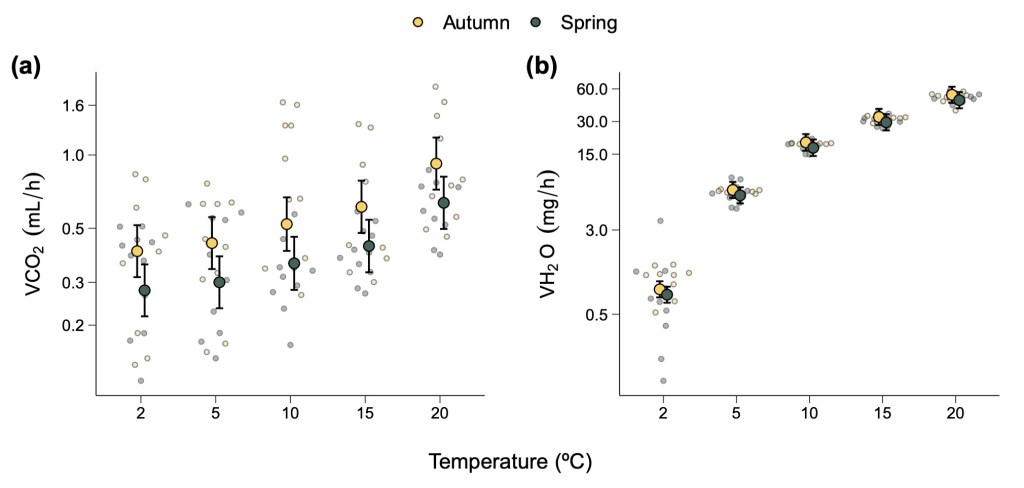
We found that increases in temperature led to increases in both SMR and EWL, demonstrating that fossorial salamanders also experience acute physiological costs when warmed. Salamanders had lower SMR in the spring, which may be beneficial in the context of overwintering emergence and breeding. In contrast, sustaining higher SMR in the autumn may allow salamanders to forage aboveground to replenish energy stores in preparation for the winter. EWL was stable between seasons, suggesting that salamanders may be more reliant on behavioural instead of physiological adjustments to manage water loss throughout the year. Together, our findings challenge the assumption that fossorial ectotherms are largely insulated from environmental fluctuations by virtue of living underground.
For more detailed information, you can access the full study here: https://doi.org/10.1007/s00442-025-05711-6
Citation
Giacometti, D, and Tattersall, GJ. 2025. Seasonal plasticity in the thermal sensitivity of metabolism but not water loss in a fossorial ectotherm. Oecologia. 207: 67. https://doi.org/10.1007/s00442-025-05711-6


 Tattersall Lab (TEMP)