A new paper has been accepted in the Canadian Journal of Zoology, resulting from Gloria Gao’s (Njal Rollinson’s lab at University of Toronto) hard work and based (in part) on the long-term study of the spotted salamanders at Bat Lake, Algonquin Park along with other field sites in Algonquin Park.
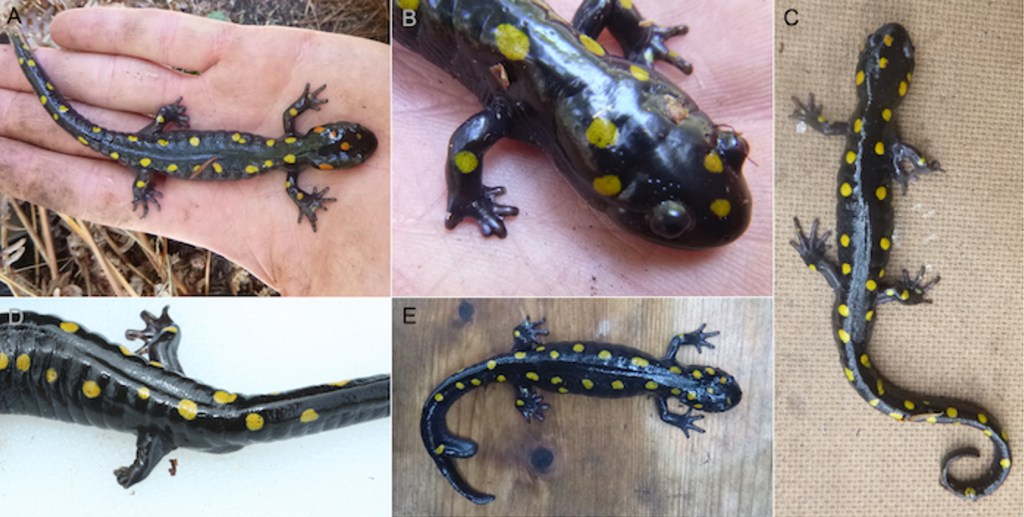
This study investigates the prevalence and fitness consequences of morphological abnormalities in Spotted Salamanders (Ambystoma maculatum) within an uncontaminated ecosystem in Algonquin Provincial Park, Canada. Over a 12-year period, the study found that abnormality rates ranged from 4.3% to 5.8% annually, aligning with baseline frequencies observed in other minimally impacted amphibian populations. Interestingly, despite expectations that abnormalities might reduce fitness, salamanders with abnormalities in this study displayed slightly higher body condition and significantly earlier arrival times at breeding sites—traits typically associated with high fitness. These results suggest a potential survivorship bias, where only individuals with favourable genetic or environmental factors survive to be observed, masking the true impact of abnormalities.
The study also highlights the importance of understanding abnormality rates in uncontaminated environments, as these can provide valuable baselines for comparison with more impacted habitats. It appears that Caudata (salamanders and newts) generally have a higher prevalence of abnormalities compared to Anura (frogs and toads), although the reasons for this remain speculative. The findings from this study underscore the complex relationship between abnormalities and fitness and emphasize the need for further research to explore how environmental factors influence these dynamics in amphibian populations.
Citation
Gao, GHY, Moldowan, PD, LeGros, DL, Sahar, M, Tattersall, GJ, and Rollinson, N. 2024. Frequency of adult amphibian abnormalities and consequences for traits related to fitness in an uncontaminated environment. Canadian Journal of Zoology, doi.org/10.1139/cjz-2024-0063.
Proofs are not yet available, but will update when they are.
 Tattersall Lab (TEMP)