Our paper using field thermal imaging in Australian birds has just been published in Biology Letters. We demonstrate that bird limbs exert greater control over peripheral heat loss than bird bills. Here is a link to the study.
Abstract
Endotherms use their appendages—such as legs, tails, ears and bills—for thermoregulation by controlling blood flow to near-surface blood vessels, conserving heat when it is cold, and dissipating heat in hot conditions. Larger appendages allow greater heat dissipation, and appendage sizes vary latitudinally according to Allen’s rule. However, little is known about the relative importance of different appendages for thermoregulation. We investigate physiological control of heat loss via bird bills and legs using infrared thermography of wild birds. Our results demonstrate that birds are less able to regulate heat loss via their bills than their legs. In cold conditions, birds lower their leg surface temperature to below that of their plumage surface, retaining heat at their core. In warm conditions, birds increase their leg surface temperature to above that of their plumage surface, expelling heat. By contrast, bill surface temperature remains approximately 2°C warmer than the plumage surface, indicating consistent heat loss under almost all conditions. Poorer physiological control of heat loss via bird bills likely entails stronger selection for shorter bills in cold climates. This could explain why bird bills show stronger latitudinal size clines than bird legs, with implications for predicting shape-shifting responses to climate change.
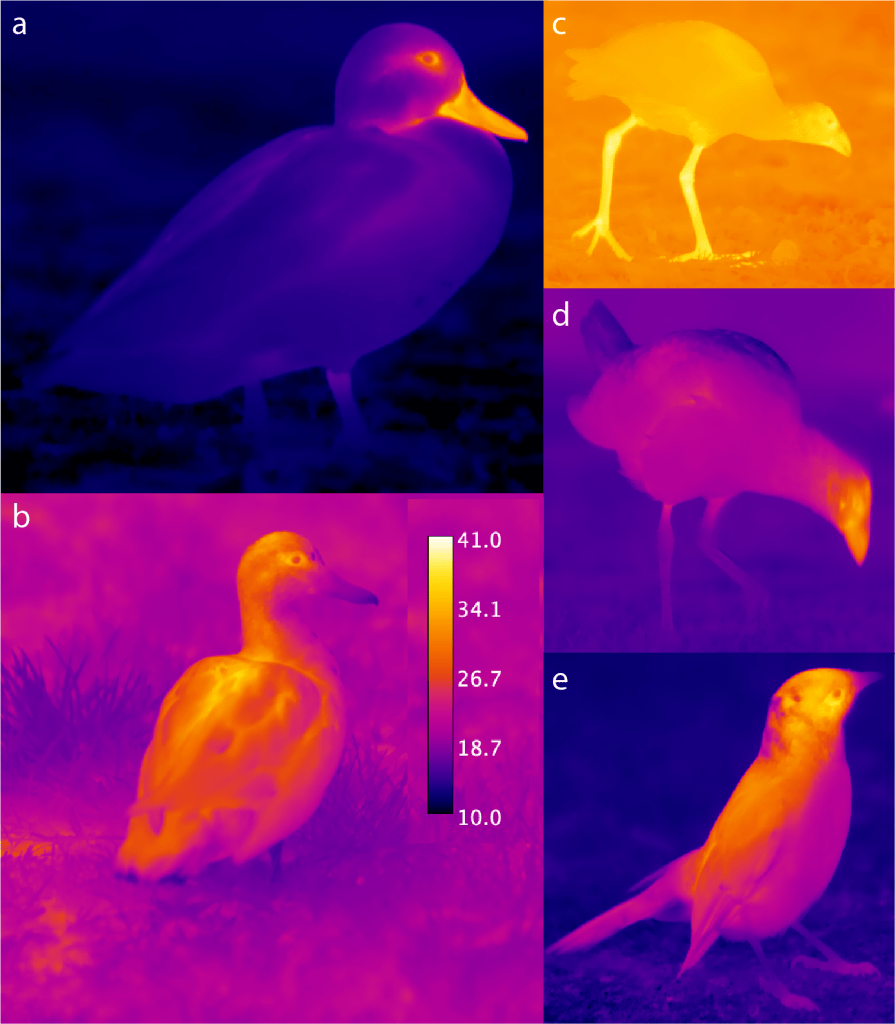
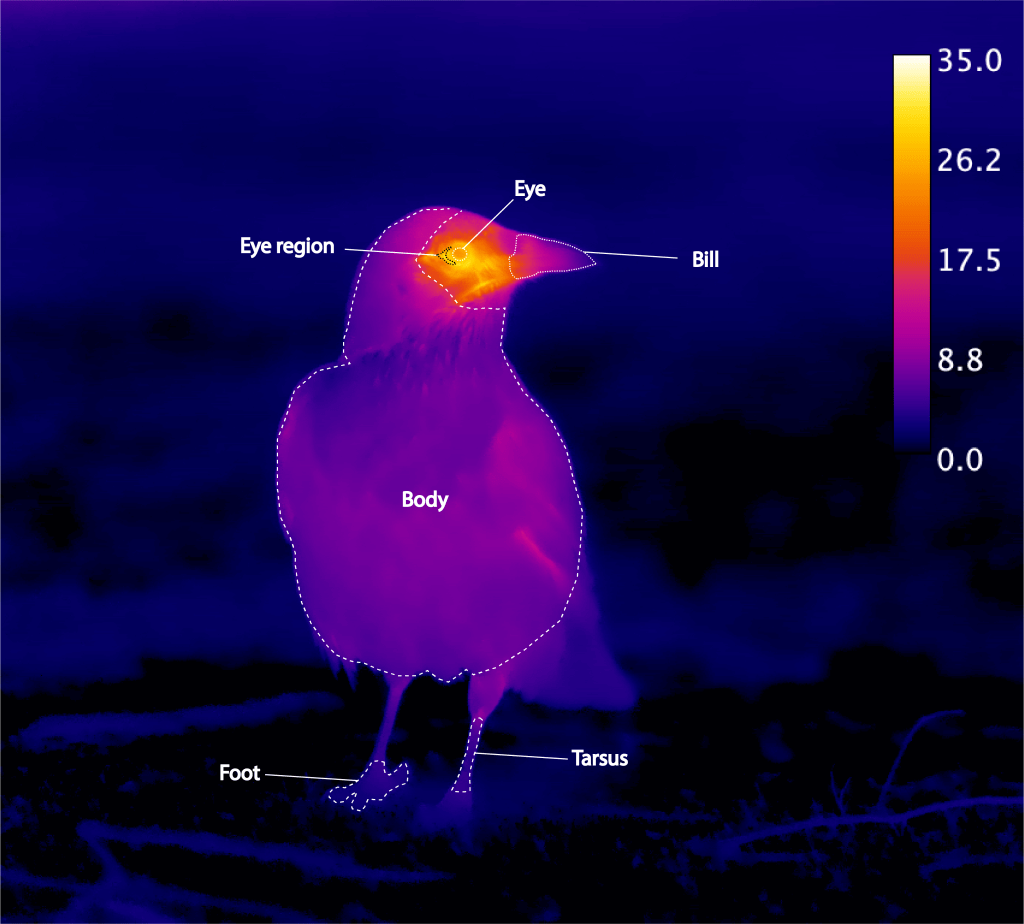

In the paper, we incorporate biophysical modelling of the two, well vascularised appendages to estimate the actual heat flux from the appendage (incorporating solar radiation, wind speed, relative humidity measurements) and then simplify this down to a simple metric of whether the appendage was losing heat or not.
Citation
McQueen, A, Barnaby, R, Symonds, MRE, and Tattersall, GJ. 2023. Birds are better at regulating heat loss through their legs than their bills: implications for body shape evolution in response to climate. Biology Letters. 19: 20230373. https://doi.org/10.1098/rsbl.2023.0373
Acknowledgements
The data from this study were collected by A McQueen and R Barnaby. We thank Scott Rolph, Robin Sinclair, Robert Moore, Mike Weston and Chris Purnell for help with fieldwork, private landowners for access to properties and reviewers for their helpful feedback. We acknowledge the Wurundjeri, Bunurong, and Wadawurrung People as Traditional Owners of the land on which fieldwork was carried out.
 Tattersall Lab (TEMP)